
Controversy over 'Debt-funded Reserves' Future Response Fund... Fiscal Experts Launch Intense Criticism
Fiscal experts gathered at the National Assembly to criticize the government's plan to establish the Future Response Fund, arguing that it involves issuing national bonds to accumulate surplus funds that will not be used immediately. The experts raised concerns regarding the National Assembly's fiscal control, fiscal rules, the distribution of authority to local governments, and the design of the fund.
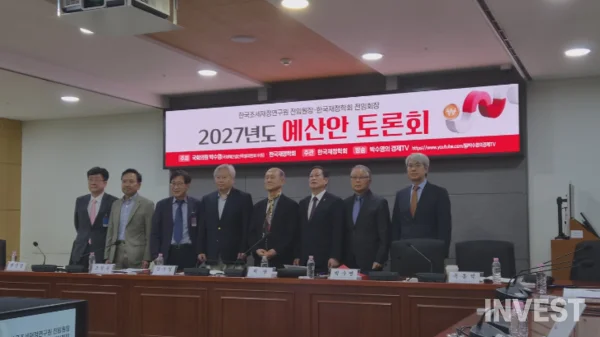
Fiscal experts gathered at the National Assembly to intensely criticize the government's plan to establish the Future Response Fund. Contrary to the intention of securing resources for future investment, they pointed out that the structure involves issuing national bonds to accumulate surplus funds that will not be executed immediately. Experts presented issues regarding the National Assembly's fiscal control, fiscal rules, the distribution of authority to local governments, and the design of the fund.
On the 12th, the '2027 Budget Proposal Discussion' was held at the 8th Conference Room of the National Assembly Members' Hall. This discussion was organized to discuss the appropriateness of the Lee Jae Myung administration's fiscal expansion stance and the establishment of the Future Response Fund.
Attendees included Kim Woo-cheol, president of the Korean Association of Public Finance, Choi Kwang, chair professor at Daegu University, Yeom Myeong-bae, professor emeritus at Chungnam National University, Ok Dong-seok, chairman of the Open Society Forum, Cho Won-dong, former Senior Secretary for Economic Affairs at the Blue House, Hyun Jin-kwon, former president of the Korean Association of Public Finance, and Hwang Seong-hyeon, professor at Incheon National University.
Criticism of National Assembly control and fiscal management regarding the Future Response Fund
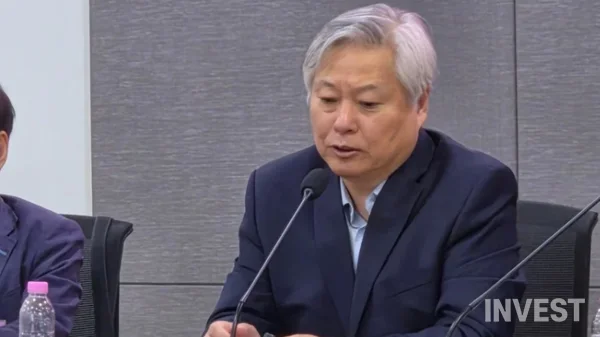
On this day, Kim Woo-cheol, president of the Korean Association of Public Finance, presented a problem regarding the structure where 104.4 trillion won in surplus funds are accumulated in the Future Response Fund while the national debt increases by 106 trillion won next year. He argued that if the National Assembly secures funds whose usage has not been determined before reviewing the budget for each project, the prior control of the National Assembly may weaken during the subsequent fund execution process.
Kim said, "Fiscal matters require permission for even all small projects one year in advance," and "If the National Assembly signs off, there will be nothing more to say from next year." The intention is that if the government issues national bonds to accumulate the fund, the National Assembly must review the scale of procurement along with the purpose of use.
He also pointed out that it is difficult to view the increased tax revenue from the semiconductor boom as a resource that will last for a long time. He noted that while tax revenue may decrease if the semiconductor industry slows down, it may be difficult to stop projects once they have started, leaving a fiscal burden.
Professor emeritus Yeom Myeong-bae criticized the approach of believing that injecting fiscal resources can solve economic problems. Yeom said, "There are things that can be done by releasing fiscal resources and things that cannot, and attempting to solve everything with fiscal resources is a kind of fiscal omnipotence."
Furthermore, Yeom pointed out that fiscal policies that do not consider the behavior of economic agents may not produce the expected effects, stating, "Economics is the study of how people respond when given certain incentives."
Agreement on utilizing excess tax revenue... Disagreement on fund design and authority distribution

Former Senior Secretary Cho Won-dong acknowledged the direction itself of utilizing excess tax revenue for future growth engines. His judgment is that in a situation where various countries are injecting fiscal resources into semiconductors and infrastructure, it is not necessarily desirable to use all additional tax revenue only for debt repayment.
Cho said, "If I were in office, I would have deliberated on how to utilize this excess tax revenue." He also evaluated the attempt to reform the local education grant system, which increases automatically based on tax revenue despite the declining school-age population, as being constructive.
However, he pointed out that if temporary resources are injected into projects that require long-term spending, projects may remain even after the resources are exhausted. Cho said, "The intention might be good, but there seems to be a significant internal problem," and stated that project periods, termination conditions, and performance management mechanisms must be prepared during the fund design stage.
Hyun Jin-kwon, former president of the Korean Association of Public Finance, pointed out that the Future Response Fund could lower the autonomy of local governments by converting part of the resources distributed to local areas into purpose-specific funds. While general resources such as local shared taxes can be used by local governments according to regional circumstances, purpose-specific funds are determined by the central government regarding the targets and project uses.
Hyun said, "It is not important how much money is actually received. It is about who the actual owner of that money is," and "This results in transferring fiscal authority located in the provinces to the center." This means that even if the amount returning to the provinces is the same, the autonomy of local finance may decrease if the authority to determine the usage lies with the central government.
Professor Hwang Seong-hyeon scrutinized the method of raising resources for the fund reserves. Hwang argued, "People think that because a lot of tax revenue is collected, it is being saved and accumulated, but that is not the case," claiming that additional national tax revenue is used for improving the existing fiscal deficit and expanding spending, while the surplus funds for the fund are provided through the issuance of national bonds.
If the interest rate on national bond issuance is higher than the return on investment of the surplus funds, interest expenses may occur during the accumulation period. Hwang argued that it would be more efficient to issue the necessary scale of national bonds when tax revenue becomes insufficient in the future rather than accumulating funds in advance by taking on debt.
He also raised issues regarding the government's method of calculating the national debt ratio. He stated that the current year's figures do not reflect the increase in Gross Domestic Product due to the semiconductor boom, while next year's figures do, comparing them with different standards. Hwang argued that if calculated with the same standard, the national debt ratio would rise from 47% this year to 48.3% next year.
Hwang did not oppose the expansion of fiscal expenditure itself. He said, "If we achieve a fiscal balance when tax revenue is good and use it only for good purposes, I think we can spend up to 12.8%," and stated that fiscal resources should be concentrated on population and social issues such as low birth rate, aging population, and polarization rather than direct industrial support.
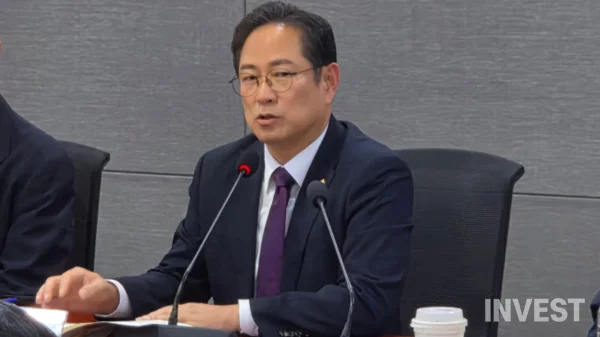
Rep. Park said she would convey the issues raised in the discussion to the National Assembly's budget review process, stating, "The members of the Strategy and Finance Committee and the Special Committee on Budget and Accounts are unable to see this due to conducting state affairs audits, but I will personally ensure that everything is conveyed so they can see it."
Covers National Assembly for INVEST NEWS GLOBAL, and also writes about Startup Is and News.
![[Company Focus] CJ Targets North America by Adding Beauty to Food and Content... Strengthening…](/storage/investnews-global/2026/10/8f745bca-6ac4-4de9-b3e1-c2b42c805993-d3208fd0-thumb.webp)
![[Company Focus] From Card Recommendations to AI Financial Assistant... Banksalad Pursues KOSDAQ Listing](/storage/investnews-global/2026/10/753be33b-68c3-4e80-b622-1ba17c7f4047-f3bbf4cc-thumb.webp)

Comments 0
Comments are currently disabled.