
[Company Focus] From a Sneaker Community to a 10 Trillion Won Valuation and IPO... MUSINSA to Lead K-Fashion's Global Expansion
MUSINSA, South Korea's leading fashion platform, is entering the IPO process 25 years after its launch, having grown from a sneaker community into a powerhouse with 5 trillion won in annual transaction volume. The company is now preparing for its next stage of growth by expanding overseas sales channels for the brands that grew alongside it.

As South Korea's representative fashion platform MUSINSA enters the initial public offering (IPO) process 25 years after its launch, attention is focused on its growth process and future steps. Having grown by attracting customers through content and supporting the production and sales of emerging brands, MUSINSA recorded an annual transaction volume of 5 trillion won last year. Now, it is preparing for its next growth phase by expanding overseas sales channels for the brands that grew together with it in Korea.
A high school student obsessed with shoes creates a fashion platform after 25 years

There was no grand business plan at the beginning of MUSINSA. Founder Cho Man-ho, who was preparing for art college entrance exams, opened an online community in 2001 to share sneaker photos and release information that he loved with others. The name 'MUSINSA' is an abbreviation of 'Muzinjang Sinbal Sajini Manheun Got,' which means 'a place with a huge amount of shoe photos.'
In the early stages of operation, there were no significant revenue sources. As the number of users increased, server costs grew, but no business foundation had been established to cover them. It is known that Cho contributed money he had saved for college tuition to operating expenses and even sold his cherished limited-edition sneakers to maintain the community.
What Cho developed first was not a shopping mall, but content. He personally carried a camera to areas like Myeong-dong and Dongdaemun in Seoul to shoot street fashion and introduced emerging designers and domestic and foreign brands. Following the independent website 'MUSINSA.com,' the launch of a fashion web magazine expanded the community of shoe lovers into a space for seeking street fashion information.
In the process of producing content, new business opportunities were also captured. At that time, emerging brands found it difficult to enter department stores or large distribution networks, and many lacked even their own marketing organizations to promote their products. On the other hand, MUSINSA had a concentration of users looking for new fashion and products. Cho connected brands and users by introducing brand products and stories through content.
The MUSINSA Store, which opened in 2009, is the result of expanding this connection into a business. Users could immediately purchase products they encountered through content on the same platform, and brands could solve both promotion and sales issues at once. Unlike the typical method of attracting customers by bringing in a large number of famous brands, the strategy was to first discover and introduce emerging brands and turn their growth into the platform's competitiveness.
After the number of customers and brands increased, the business scope was expanded. By launching its own brand, MUSINSA STANDARD, it directly reflected customer demand in its products, and by opening offline stores, it allowed customers to try on clothes that were previously sold only online. By acquiring 29CM, it also expanded its scope to female customers and lifestyle products.
The community created by Cho to share tastes has grown into a platform with approximately 11,000 partner brands and more than 16.4 million members as of the end of last year. Last year, consolidated revenue increased by 18.1% compared to the previous year to 1.4679 trillion won, and operating profit increased by 36.7% to 140.5 billion won.
MUSINSA grows only when brands grow... A mutual growth strategy

One of the strategies supporting MUSINSA's growth is mutual growth with its partner brands. The structure involves discovering emerging brands with low recognition, introducing them to customers, and having their increased sales lead to the expansion of MUSINSA's product lineup and transactions.
Founder Cho Man-ho has emphasized, "MUSINSA succeeds only when the brands succeed," adding, "The brand is 70 and MUSINSA is 30." This means that brands must come before the platform, and MUSINSA must provide an environment where brands can grow.
The scope of support has also expanded from introducing and selling brands to production, marketing, and offline sales channels. Small fashion brands must produce products for the next season in advance, but sales proceeds only come in after the products are sold. Even if they have product competitiveness, it is difficult to secure enough products to sell if they cannot secure production costs.
To reduce this burden, MUSINSA has been operating an interest-free production fund support program since 2015. According to MUSINSA, the support amount last year was approximately 80.2 billion won, and the cumulative support amount as of the end of last year was approximately 409.4 billion won. The method involves supporting the necessary manufacturing costs before sales and connecting the completed products to MUSINSA's sales channels.
Additionally, for newly joined brands with small sales scales, a separate incubating program is provided. Opportunities to promote brands and meet customers are provided through solo pop-ups, online special exhibitions, entry into offline select shops, and collaborations with influencers. Last year, 64 brands were selected, and according to company figures, their total transaction volume increased by 44.6% compared to the previous year.
A MUSINSA official stated, "We take mutual growth with brands as our management philosophy and are seeking various ways to coexist with partner companies. We will continue to strive to provide a stepping stone for small and medium-sized fashion brands to grow."
From domestic brands to overseas... Challenging IPO while expanding global distribution networks
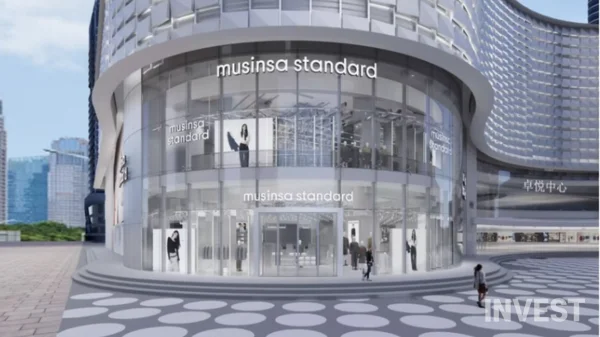
MUSINSA is expanding the co-growth method it built in Korea to overseas markets. Moving beyond merely introducing domestic brands to local consumers, the company is establishing a foundation for continuous product sales by connecting online sales with pop-ups and offline stores.
In Japan, it selected 'Matin Kim' as its first exclusive distributor partner, opening a store in Shibuya, Tokyo, and conducting pop-ups in major cities such as Osaka, Nagoya, and Fukuoka. This month, it will hold a large-scale pop-up in Osaka featuring approximately 80 K-fashion and K-beauty brands.
In China, the company plans to simultaneously open the MUSINSA Store and MUSINSA STANDARD in Shenzhen on the 31st. The strategy is to expand the local sales channels for domestic brands through the MUSINSA Store, while also building a sales network for its private brand through MUSINSA STANDARD.
Overseas business is leading to outward growth. In the second quarter of this year, the global store transaction volume increased by more than 143% compared to the same period last year. Export volume in the first half of the year also reached approximately 37.2 billion won, increasing more than ninefold compared to the same period last year. MUSINSA aims to expand its global transaction volume to 3 trillion won by 2030. Centered on Japan and China, the company plans to increase investment in local stores, logistics, and marketing to expand the overseas sales of domestic brands.
Additionally, the company is pursuing an IPO to secure the investment capacity required for overseas business expansion. On the 7th of last month, it filed a preliminary application for listing on the KOSPI market with the Korea Exchange. If it passes the exchange's review, it is expected to be listed on the KOSPI market as early as the first half of next year through the submission of a registration statement, demand forecasting for institutional investors, and general subscription. Securing funds through the listing is expected to accelerate the expansion of the global distribution network.
However, the challenge remains to connect the increase in overseas sales to stable profits. In the first half of this year, consolidated revenue was 821.7 billion won, an increase of 22.5% compared to the same period last year, but operating profit was 52.3 billion won, a decrease of 11.2%. The company explained that rising costs, such as raw materials and labor, and increased transportation costs and commissions due to expanded transactions had an impact.
MUSINSA expects that the costs invested in logistics efficiency, recruitment, and marketing in Japan and China will contribute to expanding profitability starting next year. Whether the business structure, which grew alongside domestic brands, can settle in overseas markets and whether the increased sales can be converted into profit will be key variables for future sustainable growth.
Covers National Assembly for INVEST NEWS GLOBAL, and also writes about Startup Is and News.



Comments 0
Comments are currently disabled.