
Lee Hoon-ki: "Even deviating from criteria for just two half-years avoids low PBR estimation"... Criticizes government's stock price suppression plan
Democratic Party of Korea lawmaker Lee Hoon-ki and representatives from institutional investors held a press conference to urge the passage of the Stock Price…
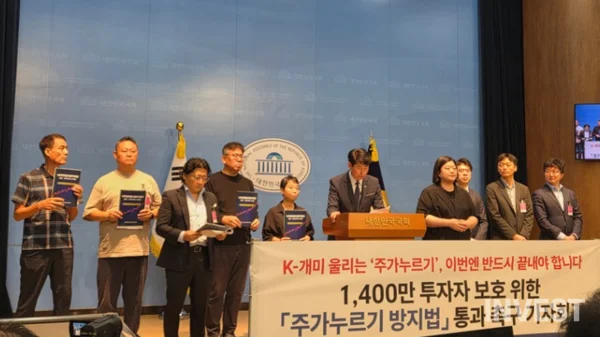
Criticism has emerged that the 'stock price suppression prevention' measures prepared by the government could be avoided simply by managing the Price-to-Book Ratio (PBR) for only a certain period. The argument is that to change the structure where a lower stock price reduces the inheritance and gift tax burden of major shareholders, a valuation floor reflecting the actual value of the company must be introduced.
Democratic Party of Korea lawmaker Lee Hoon-ki held a press conference titled 'Press Conference Urging the Prompt Passage of the Stock Price Suppression Prevention Act to Protect K-Ants' at the National Assembly Communication Hall on the 30th, emphasizing, "To resolve the economic incentive of low stock prices occurring during the inheritance and gift process itself, the Stock Price Suppression Prevention Act must be passed."
The press conference was attended by five minority shareholder representatives and three institutional investor representatives, including Kim Min-guk, CEO of VIP Asset Management, Lee Chang-hwan, CEO of Align Partners Capital Management, and Kim Ji-yeol, Director of Quad Asset Management.
Current law determines the value of inherited or gifted listed stocks based on the average stock price before and after the valuation base date. It is a structure where a lower stock price also reduces the inheritance and gift tax burden of major shareholders. Consequently, continuous criticism has been raised that maintaining relatively low stock prices is more advantageous for management succession rather than expanding dividends or shareholder return policies to increase corporate value.
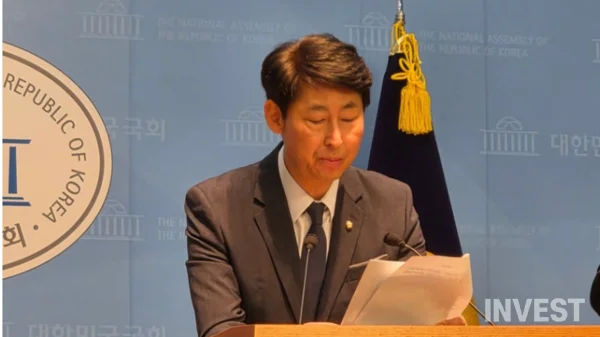
Lawmaker Lee argued that this tax structure is one of the causes that solidifies the undervaluation of domestic listed companies. He stated, "There are about 1,300 undervalued listed companies in Korea that currently do not even reach 80% of their net asset value."
According to the stock price suppression prevention plan announced by the Ministry of Finance and Economy last August, companies that fall under a certain PBR standard for 12 out of the most recent 13 half-year periods are estimated as long-term low-PBR companies. In the KOSPI market, the standard is whether the PBR falls within the bottom 25% of the industry, and in the KOSDAQ market, it is the bottom 10%.
Lee pointed out, "Even if they deviate from the criteria for only 2 out of 13 half-year periods, they can avoid the estimation requirements," adding, "Rather than continuously increasing corporate value, it allows room to avoid application by managing PBR for only certain periods." He further criticized the government plan as a 'Stock Price Suppression Neglect Act'.
Previously, President Lee Jae Myung ordered a full review on August 7, stating that the government plan failed to properly capture the original intent, but the Ministry of Finance and Economy has not yet released a revised plan.
The amendment to the Inheritance Tax and Gift Tax Act, which was primarily proposed by Lee, stipulates that if the market value of listed stocks held by major shareholders, etc., falls below 80% of the net asset value per share under tax law, the valuation method for unlisted stocks shall be applied. It is a method of setting a valuation floor so that the inheritance and gift tax burden does not decrease further when the stock price falls below a certain level.
Companies experiencing unavoidable management difficulties, such as capital impairment, rehabilitation proceedings, or management normalization agreements, are excluded from the application. The amendment also includes contents to abolish the 20% premium evaluation for major shareholders' stocks and to supplement the tax burden by allowing inheritance taxes to be paid with listed stocks.
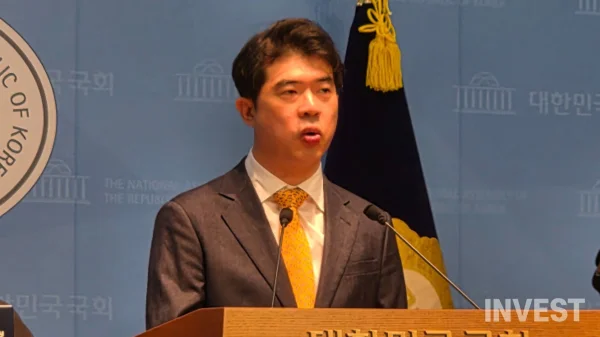
CEO Kim Min-guk said, "There are still many cases in our market where companies earn money well and have many assets, but the stock price falls far short of that value," and "While some major shareholders pay low dividends and accumulate cash in the company, they themselves excessively raise their salaries or take company profits separately through funneling business opportunities."
He continued, "Stock price suppression is not only carried out through conspicuous illegal acts," pointing out, "Since reducing dividends and accumulating profits can also be done under the name of management judgment, it is not easy for tax authorities to judge each one individually."
Kim also cited the fact that the review process of the government plan is not being disclosed to the market as a problem. He demanded, "Since the President's order for a full review, the market has no way of knowing what discussions are taking place," and "Please share with the market which direction the discussions are proceeding in."
In addition, he requested processing within the regular session, saying, "This is not a law to punish someone, but a law to make major shareholders and minority shareholders look in the same direction."
Lee said, "We must create a capital market where increasing corporate value allows both major shareholders and minority shareholders to benefit together and where citizens can trust and make long-term investments," and "We will definitely pass the Stock Price Suppression Prevention Act during this regular session."
Covers National Assembly for INVEST NEWS GLOBAL, and also writes about Startup Is and News.


Comments 0
Comments are currently disabled.