
Maritime SMR development takes at least 10 years while funds last 7–8 years... Korea Development Bank pushes for long-term investment
Experts pointed out that a long-term investment structure matching the technology development period must be established to attract private investment…
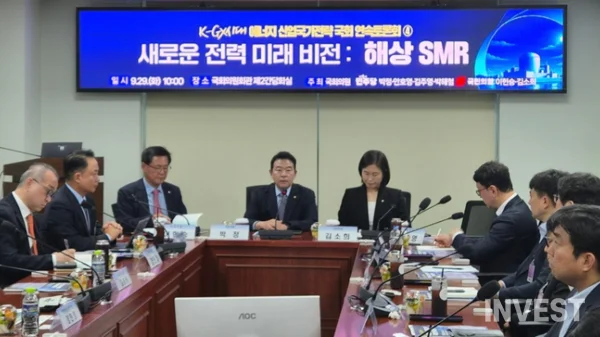
It has been pointed out that to attract private investment into the maritime Small Modular Reactor (SMR) industry, a long-term investment structure must be established that matches the technology development period. While reactor development takes at least 10 years or more, most domestic venture funds have a maturity of only 7 to 8 years, meaning the time for investment recovery arrives before the technology is commercialized.
Jeong Seong-deuk, a team leader at Korea Development Bank, explained the investment environment faced by small and medium-sized enterprises related to maritime SMRs and policy finance support measures at the 'New Vision for the Future of Power: Maritime SMR' forum held at the National Assembly Members' Hall Second Conference Room on the 29th. This forum was co-hosted by Democratic Party of Korea lawmakers Park Jeong, Ahn Ho-young, Kim Ju-young, and Park Hae-cheol, and People Power Party lawmakers Lee Heon-seung and Kim So-hui.
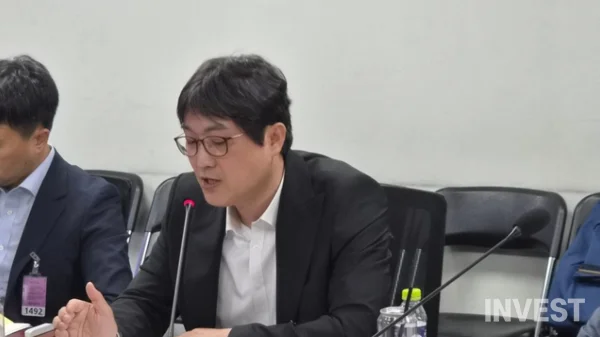
Team leader Jeong said, "While it takes at least 10 years from conceptual design to commercialization for a reactor, domestic venture funds typically have a maturity of 7 to 8 years," adding, "Since a recovery route must be found 3 to 5 years after investment, it is not easy to invest in companies that possess core technologies."
Long development period and uncertain licensing
Maritime SMR companies face not only long development periods but also the problem that it is difficult to predict the timing of licensing. Domestic nuclear power regulations and review experience have been accumulated primarily around light-water reactors. For next-generation reactors using molten salt or helium/carbon dioxide, it is difficult to set schedules for each development stage due to a lack of domestic licensing precedents.
If the form of nuclear fuel changes, separate suitability verification must also be obtained. Large amounts of capital are required at each stage to build nuclear fuel testing facilities and demonstration facilities and to construct the first prototype, but it is also not easy to secure customers to initially purchase the developed products.
Team leader Jeong pointed out, "Investors must be able to gauge the risk even if it is large, but for non-light-water reactors, it is difficult to predict the licensing period," and "While at least hundreds of billions of won are needed to construct a prototype and the first unit, it is also not easy to find customers in the private sector to purchase them first."
A suggestion was also made that the government must create initial demand to induce follow-up investment from the private sector. In the United States, the government becomes the first purchaser of microreactors and supports technology development and demonstration by supplying nuclear fuel to developers.
Team leader Jeong explained that the government should purchase initial products and lower licensing costs so that companies can endure until the commercialization stage. This means that instead of just supporting technology development, demand sources that will actually use the products must also be prepared.
Compensating for the investment gap with a fund of up to 15 years

Korea Development Bank is promoting an ultra-long-term technology investment fund to supply funds to advanced technologies with long development periods. By utilizing part of the resources from the National Growth Fund, the method involves extending the fund's duration to a maximum of 15 years and investing for more than 7 years in individual companies and projects.
The support targets include fields that require long-term funds until commercialization, such as SMRs, bio, quantum computing, space, and defense. The intention is to reduce the problem of having to recover investment funds during technology development by increasing the management period compared to existing venture funds.
The process for selecting entrusted management companies is currently underway. Korea Development Bank plans to complete the formation of the fund by the end of the year and begin executing investments from early next year. It is also promoting the establishment of professional management institutions that will conduct long-term reviews of strategic companies and projects and supply funds.
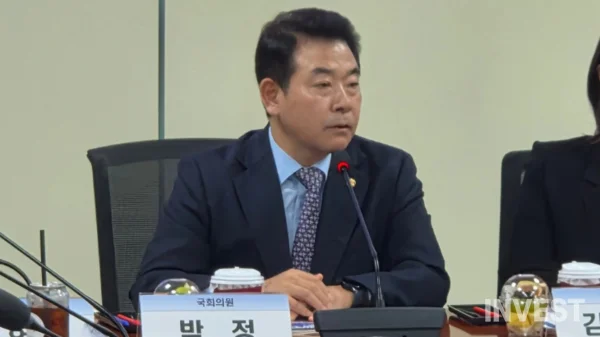
Park Jeong, who served as the chairperson of the discussion, requested, "Rather than leaving maritime SMRs only to private companies, policy finance institutions such as Korea Development Bank and Industrial Bank of Korea should participate together," and "An investment foundation must be established that can connect the construction competitiveness of the domestic shipbuilding industry with the securing of core technologies and business rights."
Covers National Assembly for INVEST NEWS GLOBAL, and also writes about Startup Is and News.
Comments 0
Comments are currently disabled.