
Open Innovation Shifts Focus from Proof of Concept to Commercialization... Large Corporations and Government Expand Follow-up Support
The focus of open innovation is shifting from simple technical verification (PoC) to actual commercialization…
The center of gravity for open innovation, which connects startups with large corporations and public institutions, is shifting from simple technical verification (PoC) to actual commercialization. As collaborations increase where startups verify their technologies using the business infrastructure and field sites of large corporations, connecting these to follow-up achievements such as purchase contracts or investments has emerged as a new challenge.
The government and large corporations are also expanding programs that support market validation and commercialization following PoC. The intention is to go beyond simply connecting startups with demand-side companies and to create a structure where verified technologies lead to actual contracts and revenue.
From Verification to Main Contracts, Commercialization Achievements Follow in Succession
Cases are appearing where startups connect PoC to actual contracts and business expansion. AI solution company Bibidi Global signed a contract for the full development of 'STORI AI Agent' and the establishment of public services with the Korea Institute of Startup & Entrepreneurship Development on the 22nd. Bibidi Global received the grand prize in the '2026 AI+ OpenData Challenge' hosted by the Ministry of SMEs and Startups by proposing an AI model that analyzes the growth history of startup companies. Following a PoC, they were selected as a preferred negotiator on the 15th, and after detailed negotiations, it led to an actual implementation contract.
STORI AI Agent is a system that builds growth histories for each company by linking and analyzing startup information scattered across K-Startup internal data and public Open Application Programming Interfaces (OpenAPI), etc. It structures participation history in support programs, major activities, and achievements in chronological order. The Korea Institute of Startup & Entrepreneurship Development and Bibidi Global plan to officially introduce it in 2027 after data integration and the establishment of an operating environment.
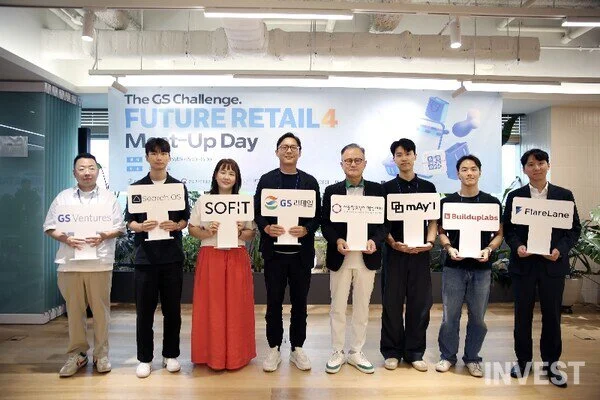
In the private sector, cases of connecting verification results to actual business are also being confirmed. GS Retail has conducted PoCs with approximately 30 startups through five open innovation programs over the past five years. The cumulative PoC support fund is approximately 1 billion won, among which follow-up achievements such as paid PoCs, main contracts, and investment execution occurred in 15 startups.
Specifically, with the AI video startup Crabs, they developed generative AI-based short-form automatic generation technology suitable for the home shopping environment and then signed a main contract. With the vision AI company Pitch AI, they verified advertising effect analysis technology at GS25 stores, and subsequently expanded collaboration through an equity acquisition. Pitch AI's technology was applied to GS25 digital signage.
Collaborations are continuing this year as well. In July, GS Retail selected five AI startups to participate in the 4th cohort of 'The GS Challenge Future Retail' and commenced a PoC lasting approximately four months. In particular, this year the program is being operated by first surveying the field demand of 17 business units and then connecting suitable startups. Key tasks include customer behavior and purchase pattern analysis, generative AI search engine optimization (GEO), and AI-based CRM automation.
However, PoC does not immediately lead to a main contract. The follow-up achievements of the existing 15 startups announced by GS Retail include not only main contracts but also paid PoCs and investment execution. Ultimately, connecting to follow-up commercialization such as actual contracts and investment after verification remains a challenge for open innovation.
From Customers to Business, Collaboration Methods are also Evolving
Open innovation by large corporations is also expanding in a direction that connects actual customers and businesses beyond PoC. KT selected 16 AI startups to participate in the open innovation program 'K-PATH 2026' last August. A total of 193 companies applied, and collaborating companies were selected across seven fields, including Enterprise AI·Agent, Physical AI·Robotics, AI Infrastructure·Model, and Industry-specific Vertical AI.
KT plans to connect the selected companies with relevant business departments to collaborate centered on actual customer projects. Targets for review include joint verification of AI digital twins in the public sector, smart factories and AI-based manufacturing innovation linked with manufacturing customer networks, and joint development of AI kiosks. In particular, the policy is to not stop at PoC but to jointly propose solutions to customers or perform projects together, and expand tasks with confirmed achievements into mid-to-long-term joint businesses.
Collaboration cases are also accumulating in existing programs. According to official K-PATH data from KT, joint commercialization and collaboration between startups and KT business departments were tallied at 19 cases for 2025–2026. During the same period, 37 KT business departments participated in the collaboration. This year, while providing up to 100 million won to startups selected as collaboration tasks, the scope of support has been widened to include joint Go-To-Market (GTM), commercialization, and customer discovery.
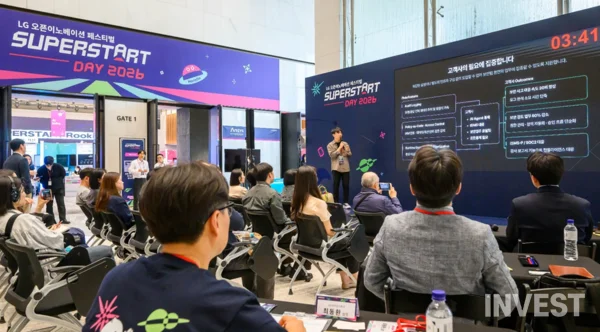
LG is also expanding collaboration opportunities with external startups. The Korea Innovation Foundation and LG Sciencepark began recruiting participating companies for '2026 Innopolis×LG Open Innovation Meet-up Day' in September. The method is to connect the technology demand of LG Group with deep tech startups within the research and development special zone, and to provide follow-up collaboration opportunities, such as PoCs with affiliates through the LG open innovation platform 'LG SUPERSTART', to companies whose technology applicability has been confirmed.
As such, the scope of support for large corporation open innovation is expanding from discovering startups and testing technologies to customer acquisition and joint business ventures. From the perspective of large corporations, they can apply external technologies to actual businesses, while startups gain opportunities to verify the marketability of their technologies by utilizing the business sites and customer networks of large corporations.
Government Strengthens Follow-up Support for Commercialization After PoC

In government policy, commercialization after PoC has also emerged as a separate target for support. The Ministry of SMEs and Startups newly established the 'Follow-up Support Program for High-performing Companies' last August. This program provides additional support for market validation (PoV) and commercialization after PoC for companies that have achieved excellent results among startups participating in existing public-private partnership open innovation and Deep Tech Value-Up programs.
PoV goes one step further than PoC, which confirms whether a technology can be implemented, to a process that verifies the value that the technology or solution can provide in an actual business environment. The Ministry of SMEs and Startups will select approximately 80 startups and provide up to 200 million won in commercialization funds per company, supporting them to conduct additional market validation with existing demand companies or to collaborate with new demand companies.
The background for establishing this separate program lies in the challenges following PoC. The Ministry of SMEs and Startups explained that it reflected field opinions that a follow-up support system is needed so that the collaboration results of existing open innovation can lead to actual commercialization and investment attraction. Accordingly, the support goal is also focused on creating follow-up results such as purchase contracts and investment attraction through market validation, rather than the PoC itself.
A project connecting public institutions as demand sources for startups is also being newly promoted. Since the 15th, the Ministry of SMEs and Startups began recruiting participating startups for the 'Public Data Utilization Support Program'. 18 agencies, including the National Data Agency, Defense Acquisition Program Administration, Korea Airports Corporation, Korea Expressway Corporation, and Korea Institute of Energy Research, have presented 22 collaboration tasks, and approximately 20 startups to perform them will be selected. Selected companies will be provided with up to 100 million won in commercialization funds necessary for collaboration with public institutions.
The business method is divided into a 'top-down' method, where public institutions first present issues they need to solve and startups propose solutions, and a 'bottom-up' method, where startups propose businesses based on the public institution data they need. It is a structure that directly connects demanders and suppliers so that the data and issues held by public institutions can be used for the validation and commercialization of startups.
As the scale of open innovation grows, future importance will lie in subsequent results rather than the number of collaborations. For startups, the key to growth is connecting the verification of technology with large corporations and public institutions to main contracts and subsequent customer acquisition, rather than the verification itself. As the government and large corporations also begin to expand their support scope to market validation and joint businesses, the criteria for judging the performance of open innovation are also shifting toward actual commercialization.
Covers IPO for INVEST NEWS GLOBAL, and also writes about Government.
![[Pre-IPO] Graphene Square, a graphene material company, secures 57 billion won in cumulative…](/storage/investnews-global/2026/09/3a67a644-fa02-4eba-996c-10de9f45fcd1-d70d3fb9-thumb.webp)
![[Series] 'LG Electronics Spin-off' Golf Course Management Robot Developer X-UP Secures Consecutive…](/storage/investnews-global/2026/09/63246a9a-a2f4-4f0d-ab00-b229f3b899c5-dc36cbcd-thumb.webp)
![[Seed] Medical AI Startup Corologic Secures Seed Investment with Cardiovascular Solution Reducing Radiation Exposure](/storage/investnews-global/2026/09/923385d5-1626-4363-a1c4-2744822e68a2-14f565b9-thumb.webp)
Comments 0
Comments are currently disabled.