
[Seed] Medical AI Startup Corologic Secures Seed Investment with Cardiovascular Solution Reducing Radiation Exposure
Cardiovascular imaging AI medical device startup Corologic has secured seed investment from Kakao Ventures and SNU Holdings.
Cardiovascular imaging artificial intelligence (AI) medical device startup Corologic has secured seed investment from Kakao Ventures and SNU Holdings. The investment amount was not disclosed. This investment is the first external funding Corologic has secured within four months of its establishment, and the funds will be invested in enhancing the performance of its flagship product, conducting multi-center clinical validation, and preparing for domestic and international regulatory approvals and commercialization.
Corologic is a company established in May 2026, based on the cardiovascular imaging research achievements of Professor Si-Hyuck Kang's research team in the Department of Cardiology at Seoul National University Bundang Hospital. The company is developing software medical devices that support medical staff in confirming the imaging information necessary for procedures while reducing the radiation burden on both patients and medical staff during cardiovascular intervention procedures such as coronary angiography.
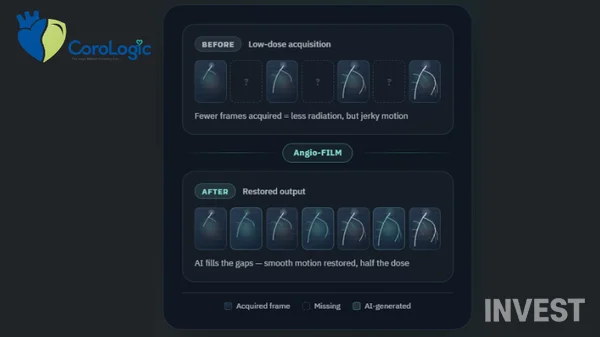
Coronary angiography is a test and procedure in which the presence of stenosis in heart vessels and blood flow are checked through continuous X-ray-based images after administering contrast agents. During the procedure, one must continuously observe the vessels moving according to the heartbeat, the movement of the contrast agent, and the position of catheters and medical devices. While lowering the number of shooting frames can generally reduce radiation exposure, it can create limitations for the practitioner in grasping the movement of vessels and contrast agents as the image movement may appear broken.
Corologic's flagship product 'Angio-FILM' (model name AF100) overcomes these limitations. AF100 analyzes the preceding and following frames of images captured at low frames and generates images of the points in between using AI, thereby supplementing temporal continuity. It is designed to add intermediate frames to images captured at 7.5 frames per second, allowing them to be displayed at a level of 15 frames per second.
In particular, AF100 focuses not just on simple image correction, but on maintaining the imaging information that must be confirmed during the procedure, such as coronary artery movement according to the heartbeat and contrast agent flow. Corologic developed the algorithm based on clinical imaging data accumulated at Seoul National University Bundang Hospital, and the development dataset utilized approximately 377,000 angiographic image clips from 28,907 patients.
Another feature is that it is configured to be compatible with existing angiography equipment without replacing it. Images captured at low frames are processed on the hospital's internal server and then transmitted to the existing imaging system in DICOM format, the medical imaging standard. This was done to allow use within the existing work environment of the cardiovascular angiography room by reducing separate file export or image conversion procedures. However, in the actual installation and operation stages, it is necessary to check the compatibility of the imaging systems and equipment for each hospital.
Currently, AF100 has completed the declaration of manufacture for a Class 1 product. Corologic plans to accumulate the clinical evidence necessary for introduction to medical sites through subsequent product enhancement and multi-center clinical validation, and sequentially pursue obtaining ISO 13485, the international medical device quality management system certification, as well as regulatory approvals from the Ministry of Food and Drug Safety and the FDA 510(k) procedure in the United States.
Hwang Kyung-rae, CEO of Corologic, said, "Corologic is focusing on creating an environment where medical staff can confirm the information needed for procedures while reducing the radiation burden on both patients and medical staff. Based on this investment, we will promote introduction to medical sites by securing product completeness and clinical evidence."
Corologic focused on concretely presenting not only the potential of AI technology to be used in cardiovascular angiography rooms but also the reason the technology is needed, the users, and the productization process. Based on the research achievements accumulated by Professor Si-Hyuck Kang's research team at Seoul National University Bundang Hospital, the company has established a foundation for commercialization, including publication in international academic journals, transfer of original technology, and product manufacturing declaration. They also explained the plan to link the image restoration performance secured during the research stage to clinical evidence in actual low-frame shooting environments.
Under the judgment that medical AI is difficult to be introduced to the field based on algorithm performance alone, the team also emphasized its execution capability. The structure involves CEO Hwang Kyung-rae, who has 24 years of experience in business and management in the cardiovascular medical device field; CMO Si-Hyuck Kang, who understands the procedure site; and CTO Choi Young-rak, who possesses experience in medical imaging equipment and AI product development, taking charge from defining clinical demand to technical implementation and productization.
The investment funds will be prioritized for multi-center clinical validation, product enhancement, regulatory approval, and establishment of a quality system. Research is being prepared to evaluate changes in radiation dose, preservation of vessel and lesion information in restored images, and feasibility of application in medical sites in actual low-frame shooting environments at domestic medical institutions, including Seoul National University Bundang Hospital. After undergoing necessary procedures such as review by each institution, they plan to expand clinical evidence by verifying performance in images from external medical institutions.
In terms of the product, funds will be used to improve image restoration quality, processing speed, and operational stability. They plan to increase processing performance so that medical staff can check the captured images more quickly and strengthen the integration stability with existing hospital imaging systems. Along with this, they will pursue ISO 13485 quality management system certification and prepare products and clinical data required for Class 2 medical device approval from the Ministry of Food and Drug Safety.
Having experienced business and management in the cardiovascular medical device field for 24 years, I have witnessed the advancement of therapeutic instruments and imaging technology. However, the challenge of whether it is possible to reduce the radiation burden not only for patients but also for medical staff who repeatedly participate in procedures still remains. The issue of radiation exposure is linked not only to the examination and treatment process but also to the working environment of medical staff.
Corologic approached this problem by combining the clinical awareness of Professor Si-Hyuck Kang's research team with experience in the cardiovascular medical device industry. We saw that by linking software to the angiography equipment owned by hospitals and restoring the lost temporal information in low-frame captured images, the scope of low-dose imaging utilization could be expanded. Corologic was established to realize the possibilities verified during the research stage into products that can be used in actual procedure sites.
Over the next 1 to 2 years, we will focus on connecting the technical possibilities of Angio-FILM to multi-center clinical evidence and hospital adoption. We plan to advance image restoration quality, processing speed, hospital system integration, and operational stability, while preparing quality management systems and additional permits to establish a foundation for stepwise adoption.
Overseas, we will simultaneously prepare for permits and discover angiography equipment manufacturers and commercialization partners. Corologic presented related research and demonstrated its technology at EuroPCR 2026 held in Paris, France, this May, and plans to participate in BioJapan 2026 held in Yokohama, Japan, from October 7 to 9 to discuss technical cooperation and commercialization plans with overseas partners.
In the medium to long term, based on the technology and clinical experience accumulated in the field of coronary artery imaging, we will review the possibility of application to other interventional procedure fields such as pediatric cardiology, cerebrovascular, and peripheral vascular. However, as the imaging characteristics and clinical environments of each area differ, expansion will be predicated on securing separate data and performing performance and clinical verification. Ultimately, our goal is to contribute to establishing a low-dose cardiovascular procedure environment that reduces radiation burden while maintaining necessary imaging information.
Medical device entrepreneurship must start from the problem to be solved and the actual usage environment rather than the technology itself. You must be able to answer who should use the product, in what situation, and why, and the process of understanding the medical staff's workflow and hospital adoption conditions should be the starting point for product design.
In this process, permits, quality control, and clinical verification should be viewed not as tasks to be solved after development, but as a process of concretizing the product's reliability and usage value. If you review the necessary evidence and regulatory pathways from the early stages, you can reduce trial and error. Additionally, field experience is an important asset in the entrepreneurship process, and when personnel with different expertise collaborate, they can define problems more accurately and create actionable solutions.
As an early-stage company, Corologic must also continuously verify product performance and clinical value. It is important to distinguish between confirmed facts and areas requiring additional proof, and to reduce that gap. We also view attracting investment not as an end in itself, but as a process of securing opportunities to verify the value promised to customers and the medical field.
※ This article was written after verifying the facts through investigation.
Comments 0
Comments are currently disabled.