
To Increase AI Data Center Investment... "Must Evaluate Computing Power Beyond Buildings"
Experts at an industrial forum argued that to attract private investment into AI data centers, financial evaluations must move beyond land and buildings to assess computing power and utilization rates. They emphasized the need for financing structures tailored to different asset lifecycles, such as long-term facilities versus short-lived GPUs.

It was pointed out that to attract private investment into Artificial Intelligence (AI) data centers, financial examinations must move away from being centered on land and buildings and instead evaluate computing power and utilization rates. The argument is that since buildings, power facilities, and Graphics Processing Unit (GPU) lifespans differ, financing structures suited to the characteristics of each asset are necessary.
At the 'Leap Toward Becoming a Powerful Intelligent Production Nation in Korea' industry forum held at the National Assembly Members' Office Building's 1st Seminar Room on the 6th, ways to establish a national production system connecting AI semiconductors, power, data centers, and industrial finance were discussed.
The presentations began with KAIST Professor Yoo Hyeon-gyu's 'AI Semiconductor · National Silicon Strategy,' followed by Sejong Institute Senior Research Fellow Cheon Yeong-jun's 'Power · AIDC · National Intelligent Production Infrastructure,' and finally Park Hye-jin of Sogang University's '1,000 Trillion Won Intelligent Production Industrial Finance.'
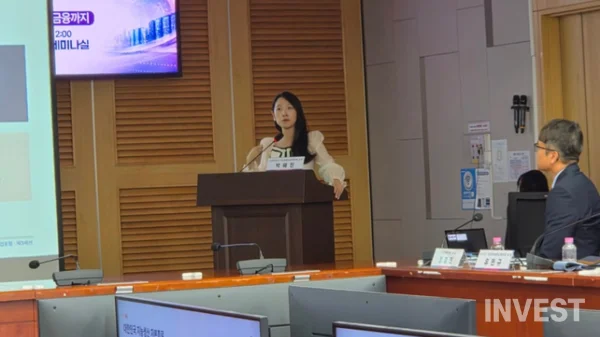
Professor Park, who presented on the topic of industrial finance, emphasized that to supply funds to AI infrastructure, one must distinguish the characteristics of each asset, evaluate their value, and prepare exit routes for investment recovery.
She stated, "Finance does not enter if there is no way to exit," adding, "Capital that can wait decades while waiting for revenue to be generated is bound to be limited."
She also viewed that since the usage periods of the assets constituting a data center differ, the investment recovery periods should also be set differently. While buildings and power facilities are used for a long time, GPUs and servers have short replacement cycles due to technological changes. Therefore, she explained that financing and recovery structures should be designed separately for long-term facilities and equipment with short replacement cycles.
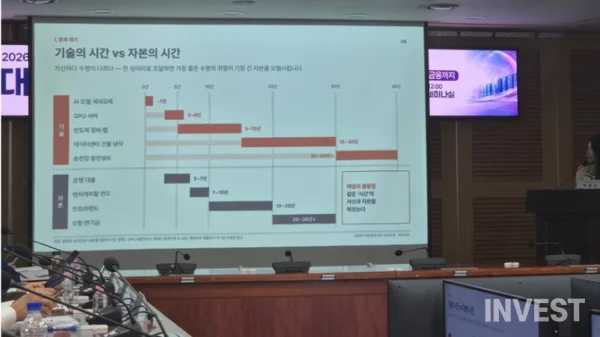
Professor Park said, "It is extremely important to recognize that the lifespan of specific technologies and the lifespan of capital are different and to connect those whose lifespans match."
Specifically, she suggested using policy finance and green bonds for power and cooling facilities, and utilizing leases, equipment finance, and asset-backed securitization for GPUs and servers. For software and services, where business periods and risks are variable, she viewed venture capital or strategic investment from corporations as suitable.
As criteria for judging asset value, she presented computing service usage contracts, utilization rates, the speed of technological obsolescence, and customer creditworthiness. She argued that real estate evaluations centered on rent and vacancy rates make it difficult to sufficiently grasp the profitability and risk of AI infrastructure.
She said, "To evaluate AI production assets, an infrastructure must be established that can constantly evaluate data in real time." To this end, she proposed standardizing and verifying field data, such as GPU utilization rates, power procurement contracts, and equipment status, so that financial institutions can use them commonly.
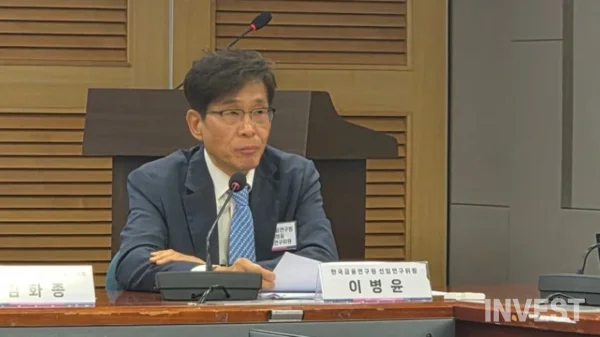
Lee Byeong-yun, Senior Research Fellow at the Korea Institute of Finance, who participated in the discussion, also agreed with the improvement of the evaluation system and emphasized the expansion of the evaluation capabilities of the financial sector.
Researcher Lee pointed out, "To conduct investments or loans, the financial sector must possess the ability to evaluate semiconductor performance, replacement cycles, and power fee structures when evaluating data centers, but currently, it seems they lack such capabilities." He suggested that private financial institutions should develop their own capabilities and establish a cooperative system with policy finance institutions that possess technology evaluation experience and data.
Along with securing evaluation capabilities, he viewed that policy finance should share investment risks that are difficult for the private sector to bear. He said, "Even within the same project, policy finance should enter as a junior tranche or take the lead in sharing losses to induce the private sector to enter as a senior tranche." This means inducing private sector investment participation through a structure where policy finance bears losses first if they occur.
He also emphasized that after investment, performance monitoring and fund recovery plans are necessary. Researcher Lee said, "It is also necessary to faithfully prepare post-management processes regarding how to monitor performance after investment and how to implement recovery strategies."
Covers National Assembly for INVEST NEWS GLOBAL, and also writes about Startup Is and News.
![[Company Focus] From a Sneaker Community to a 10 Trillion Won Valuation and IPO... MUSINSA to Lead…](/storage/investnews-global/2026/10/3826b096-3788-4543-9f6b-683f99b389e9-802e4fa8-thumb.webp)


Comments 0
Comments are currently disabled.