
[IPO] Jincostech leaving KONEX, will hydrogel growth continue... Public offering subscription ratio 685 to 1
Jincostech, a company specializing in hydrogel, is moving from KONEX to KOSDAQ with a public offering subscription ratio of 685 to 1. While the company shows strong growth and technical capabilities, risks such as high floating shares and potential regulatory sanctions remain.
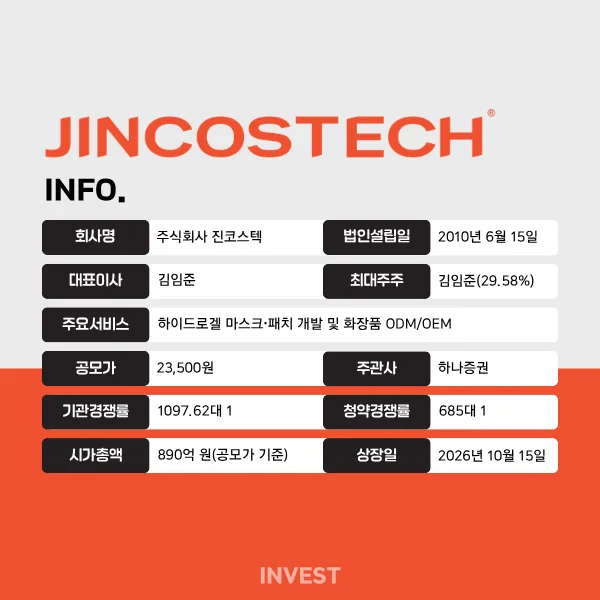
As the global growth trend of K-beauty continues, interest in the initial public offering (IPO) market for cosmetics companies also persists. Jincostech, which specializes in the hydrogel field, is moving to transfer its listing to KOSDAQ, highlighting its differentiated technology, mass production capabilities, and recent growth trends. In particular, as it pursues a transfer listing from KONEX to KOSDAQ, attention is focused on whether its corporate value will be re-evaluated after listing.
According to the lead manager, Hana Financial Investment, the results of Jincostech's public offering for general investors, conducted from the 2nd to the 6th, recorded a competition ratio of 685 to 1. The number of subscription cases was 147,227, and the deposit amount collected was approximately 1.7144 trillion won. Jincostech recruited a total of 852,000 new shares in this offering, of which 213,000 shares, or 25%, were allocated to general investors. The total offering amount is approximately 20 billion won, and it is scheduled to be transferred and listed on the KOSDAQ market on the 15th.
Previously, during the demand forecasting for institutional investors conducted from the 16th to the 22nd of last month, 2,006 institutions participated, recording a competition ratio of 1,097.62 to 1. Out of the total requested volume of 701,380,000 shares, about 86% were concentrated at or above the upper end of the desired band (19,500~23,500 won), and the offering price was finalized at the upper limit of 23,500 won. The mandatory holding commitment application ratio was limited to 5.29% in terms of quantity. Compared to the high institutional interest, the intention for long-term holding is at a limited level, so the supply and demand after listing needs to be monitored.
The volume of shares available for distribution immediately after listing is also a burden factor. Based on the securities report, out of the 3,786,533 shares scheduled to be listed, 2,212,851 shares (58.44%) can be traded in the market immediately after listing. This is worth 52 billion won based on the offering price, which is more than half of the expected market capitalization of 89 billion won. Since this includes shares held by existing shareholders, the release of volume in the early stages of listing may increase stock price volatility, but there are currently no additional dilutable securities such as stock options, convertible bonds, or bonds with warrants.
There is also a history of voluntary reporting regarding potential violations of past public offering regulations. Jincostech confirmed the possibility of violating the submission of securities reports and resale restriction obligations during some stock transfers and fund-raising processes in the past and voluntarily reported this to the Financial Supervisory Service. As of the date of the securities report submission, no separate measures have been imposed, but the possibility of sanctions remains depending on the results of the investigation by the Financial Supervisory Service. The company explained that if sanctions are imposed in the future, it may affect the listing schedule or profits and losses.
Jincostech Business Analysis
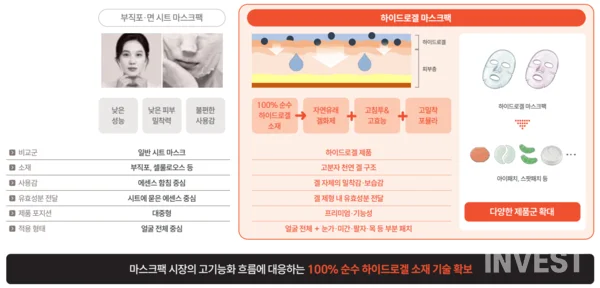
Jincostech's business competitiveness lies in its formulation technology specialized in hydrogel and its mass production capabilities. It has an ODM·OEM system that performs the entire process from product planning and formulation design to production, mass production, and quality control. It holds differentiated technologies and related patents such as hybrid·capsule hydrogel and water-pattern control.
Hydrogel is a multi-step process involving raw material mixing, high-temperature coating, cooling·molding, and perforation, making formulation stability and yield management important. Based on accumulated mass production technology, the company proposes a hydrogel eye patch market share of 63.84% for 2025. However, it should be noted that this is an estimate made by the company based on the sales of some major companies, rather than a survey by an independent organization targeting the entire market.
The company is also pursuing an expansion of production capacity to respond to increased demand. In the first half of 2026, the total utilization rate of hydrogel reached a virtually saturated level of 98.61%. Accordingly, Jincostech plans to build a third factory in Siheung and expand its production capacity (CAPA) by more than 40% from the current level. As the high utilization rate shows robust demand, whether the company can link the future expansion volume to actual new orders and sales will determine the sustainability of its growth.
Expansion of customers and overseas markets is also a growth axis. Jincostech is broadening its customer base to brand companies, distributors, and vendors, and is supplying products to overseas markets such as the United States and Vietnam. In the first half of 2026, export volume was approximately 8.2 billion won, accounting for 26.5% of total sales. However, due to the nature of the ODM business, where individual orders are centered rather than long-term supply contracts, the scale of orders may vary depending on the sales performance or changes in the sourcing strategy of customer brands.
The fact that it places a high proportion on hydrogel is both a strength and a risk. The proportion of hydrogel products in total sales increased from 86.34% in 2025 to 89.11% in the first half of 2026. If the market growth continues, benefits may be concentrated, but it could be heavily affected if consumption trends change, alternative formulations emerge, or the entry of large ODM companies becomes full-scale.
Jincostech Performance and Fund Usage Plan
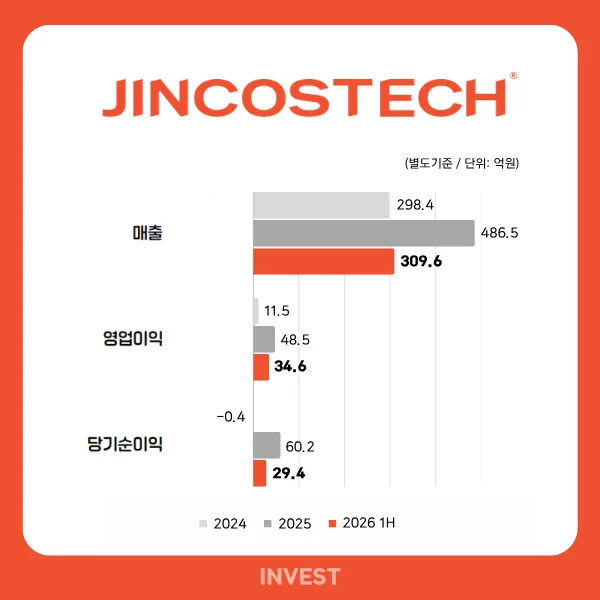
Jincostech's profitability is also improving along with its recent external growth. The operating profit, which turned a profit in 2024, increased significantly, recording 4.9 billion won last year, and the operating profit margin also rose from 3.9% in 2024 to the 10.0% level in 2025. This is the result of the simultaneous expansion of hydrogel mask·patch sales and improvement in the cost ratio. Last year's net profit also turned a profit at 6 billion won.
The growth trend continues even this year. In the first half of 2026, revenue increased by 33.5% compared to the same period last year, operating profit increased by 33.9%, and the operating profit margin maintained double digits at 11.2%. However, net profit decreased by 19.0% compared to the same period last year. This was affected by the base effect, as net profit was relatively high in the same period last year due to the reflection of corporate tax income.
In the process of expanding its external scale, the burden of working capital is increasing. At the end of the first half of this year, accounts receivable amounted to approximately 7.6 billion won, more than doubling from 3.1 billion won at the end of last year, and inventory assets also increased from 4.4 billion won to 7.1 billion won during the same period. In particular, the inventory of raw and auxiliary materials increased significantly. While this is in terms of securing inventory to respond to sales growth, if the growth trend slows down in the future, the increased inventory and accounts receivable could act as a working capital burden.
In the first half of this year, the cash flow from operating activities recorded a net outflow of 500 million won, turning negative from the net inflow in the same period last year. On the other hand, cash and cash equivalents increased from 6.5 billion won at the end of last year to 7.8 billion won at the end of the first half. As the inflow of funds through financing activities such as paid-in capital increases influenced the increase in cash, whether cash is generated through operating activities along with sales and profit growth is also cited as a major variable in the future.
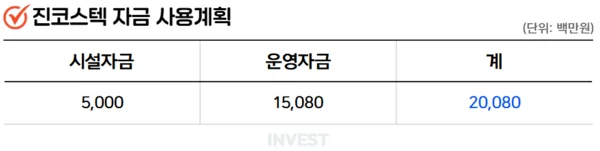
Jincostech will raise approximately 20 billion won through this public offering. The net proceeds, excluding issuance expenses and including the mandatory underwriting portion of the listing manager, are 20.1 billion won, which the company plans to use for expanding production capacity, research and development, and business operations.
Specifically, 5 billion won has been allocated as facility funds for the construction of production facilities and auxiliary facilities for the third factory. The company plans to complete internal construction and production equipment installation by the end of this year and, through trial runs and test production, enter mass production within March 2027. Once the third factory is operating normally, the annual production capacity of hydrogel products will expand by 49.7% from the existing 43.44 million units to 65.04 million units.
The remaining 15.1 billion won will be used as working capital. Of this, 6 billion won will be used to secure raw and auxiliary materials in preparation for the operation of the third factory, and 4 billion won will be invested in the research and development of new hydrogel products and new formulations from 2026 to 2028. The remaining 5.1 billion won is scheduled to be used for personnel recruitment, expansion of domestic and overseas sales, and management of the third factory.
Covers IPO for INVEST NEWS GLOBAL, and also writes about Government.
![[IPO] Melcon, which broke into ASML's supply chain, sees 1741:1 subscription success…](/storage/investnews-global/2026/10/438e9014-fc3f-4639-8859-cddd6ebb70c8-e99a38ca-thumb.webp)
![[IPO Preparation] Solis, Luxco, and Celtrix Kick Off KOSDAQ Entry via 'SPAC Mergers'](/storage/investnews-global/2026/10/aa0fdeae-830d-43fa-baca-8c9e2c87cbd1-716433f2-thumb.webp)
![[IPO] Robot-related stock BRILS sees successful public subscription... Demand forecast exceeded with 1676:1 ratio](/storage/investnews-global/2026/09/5a782278-8e68-4e95-835d-ad9dcfc822b2-bb3d9d93-thumb.webp)
Comments 0
Comments are currently disabled.