
[IPO] Semiconductor stock Global Technology sees 57-to-1 general subscription ratio... Entering the market with lowered offering price
Global Technology is proceeding with its KOSDAQ listing by lowering its offering price to reduce valuation expectations.
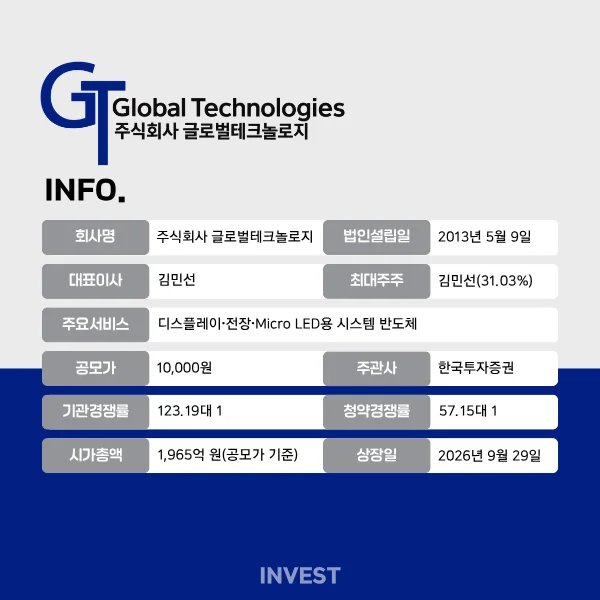
Global Technology is proceeding with its KOSDAQ listing by lowering its offering price to reduce valuation expectations. As the entry price has been lowered, attention is focused on whether it will be perceived as undervalued in the market after listing, or whether the price proposed by institutions will establish itself as a new benchmark for the company's value.
Global Technology recorded a competition ratio of 57.15 to 1 in the general public subscription held on the 16th and 17th, with Korea Investment & Securities serving as the lead manager, securing approximately 285.8 billion won in deposits. The total offering consists of 4 million new shares, of which 1 million shares were allocated to general investors. The total offering amount is 40 billion won, and the expected market capitalization after listing is approximately 196.5 billion won.
Previously, during the demand forecasting for institutional investors, 961 domestic and foreign institutions participated, recording a competition ratio of 123.19 to 1. Among the requested quantities, the portion that proposed a price at or below the lower end of the desired offering price band (13,000–15,000 won) reached 83.86%, while the portion proposing at or above the upper end was only 16.01%.
Ultimately, the company chose to lower the burden of corporate valuation by fixing the final offering price at 10,000 won, which is 3,000 won lower than the bottom of the desired range. The mandatory holding commitment stood at only 0.27% based on the requested quantity. Although the adjustment of the offering price lowered the entry price for new investors, it was not an IPO that showed a strong intention for long-term holding by institutions.
On the other hand, the supply and demand burden immediately after listing is relatively limited. The volume immediately available for circulation after listing is 4,359,571 shares (22.19%). Since a significant portion of the shares held by the largest shareholder and major investors is locked up under a lock-up period, the proportion of existing shareholder shares in the initial floating volume is not large. However, one month after listing, the floating volume is expected to expand to around 32% as the volume from venture finance and professional investors is released into the market.
Global Technology Business Analysis
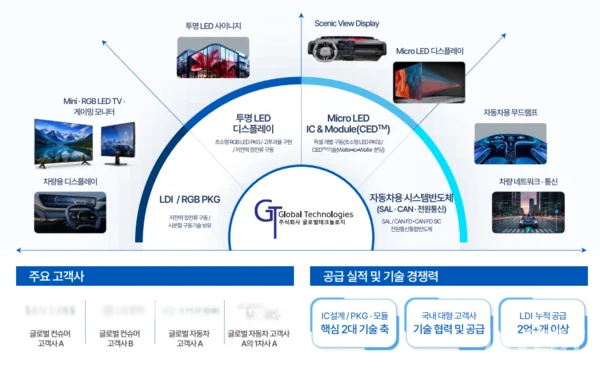
Global Technology is a fabless company whose main product is LDI (LED Driver IC), a semiconductor that controls the LED light source of displays. Rather than operating its own production facilities, it focuses on semiconductor design and has grown its business centered around LDIs for TVs and monitors. Its cumulative supply volume has exceeded 200 million units.
The structure of LDI is such that the number of units embedded per product increases as displays become more advanced. According to company data, while the LDI embedding amount is limited in LCD TVs, it can increase from about 5 units per set in LED TVs to 100–800 units in Mini LED, 1,000–1,500 units in RGB LED, and 2,400–3,500 units in Micro LED. This is because as the number of LEDs constituting the screen increases, each light source must be precisely controlled.
Global Technology has been expanding its product development scope by adding packaging, module, and optical design capabilities to its existing LDI design technology. Recently, it has been moving its business stage to automotive electronics. In 2025, it established a joint research institute with Hyundai Mobis and commenced the development of automotive lighting and display semiconductors, and is developing automotive Mini/RGB LED Driver ICs and dimming control ICs.
The automotive product group is expanding into the fields of lighting and communication. The company has completed the domestic development of semiconductors for vehicle interior lighting control and CAN IC used for communication between electronic control units within vehicles. In the future, it plans to expand its product lineup to include CAN FD and integrated power/communication semiconductors.
However, in the automotive electronics business, product development does not immediately translate to revenue. Actual supply begins only after passing stages such as performance and reliability verification, quality approval, and mass production following adoption by customers. The existing LDI business also has a structure where revenue is generated according to the product platforms and production schedules of customers. Ultimately, the key factor for future business performance will be how effectively the automotive semiconductors currently under development can be linked to actual mass production and revenue based on the existing display business.
Global Technology Performance and Fund Usage Plan
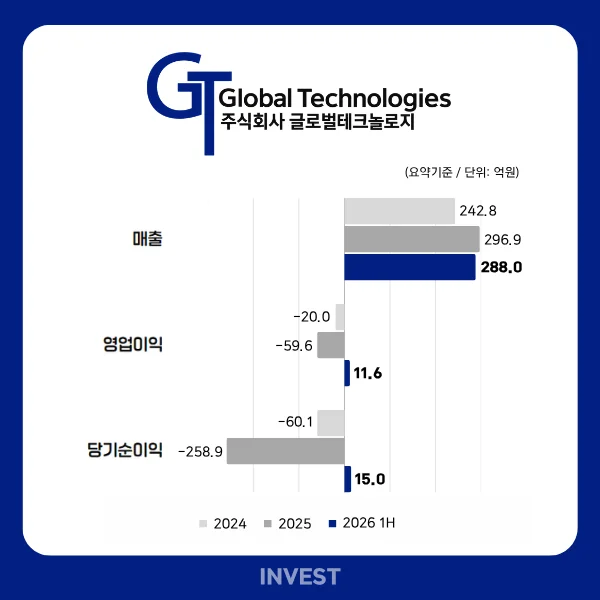
The turnaround in Global Technology's performance was driven by the recovery of the LED business. Revenue for the first half of 2026 was 28.8 billion won, an 88.8% increase compared to the same period last year. Looking at business units, while LED business revenue increased more than fourfold from 4.8 billion won to 20 billion won, IT component wholesale revenue decreased from 10.5 billion won to 8.8 billion won. This means the overall growth in scale did not stem from a simple expansion of the wholesale business but from the revenue increase of the core semiconductor business.
An improvement was also seen in operating profit and loss in the LED business. The LED business turned from an operating loss of 2.8 billion won in the first half of last year to a profit of 300 million won this year. However, out of the total operating profit of 1.2 billion won, 900 million won was generated from IT component wholesale. Although the center of revenue growth has shifted to LED, it has not yet reached the stage where the profit contribution is also reorganized around the LED business.
The gap between last year's net loss of 25.9 billion won and this year's net profit of 1.5 billion won reflects not only the performance of the core business but also the impact of changes in the capital structure. In 2025, the net loss expanded significantly more than the operating loss as derivative evaluation losses related to Redeemable Convertible Preferred Shares (RCPS) were reflected as financial expenses. As those preferred shares were converted into common shares this January, the burden of related evaluation gains and losses was greatly reduced, and financial expenses for the first half of this year decreased to the level of 700 million won.
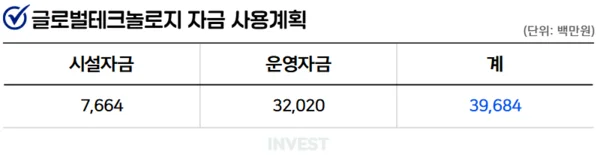
Global Technology secured approximately 39.7 billion won in net proceeds through this offering. Among this, the largest portion of 20.5 billion won will be invested in research and development (R&D). The company plans to continue the development of new products such as Micro LED and CAN FD, as well as the advancement of existing semiconductor products.
9.3 billion won has been allocated to securing raw materials. Since it takes a considerable amount of time from ordering to the supply of wafers, this is largely a preemptive capital injection to respond to the mass production schedules of customers. In addition, 7.7 billion won will be used for facility funds, such as establishing Micro LED development lines, and 2.2 billion won will be used for upgrading the ERP system and acquiring intellectual property rights.
![[IPO] 'First Exception to Dual Listing' Duksan Navcours heads to KOSDAQ riding K-Defense exports…](/storage/investnews-global/2026/09/c6e9f52a-f52c-4c26-9f07-df075645f280-53750d9a-thumb.webp)
Comments 0
Comments are currently disabled.