
[Field Report] 2026 Laplace × ETRI Deep Tech Investment Forum: 16 VCs and Asset Managers Participate, Focusing on Commercialization Verification
The '2026 Laplace × ETRI Deep Tech Investment Forum' was held at the MARU180 Event Hall to connect core technologies from public research institutes…
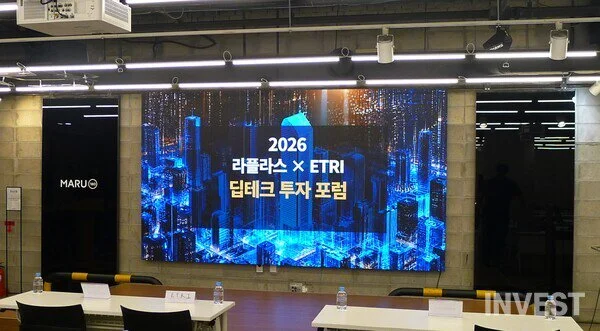
On the 14th, the '2026 Laplace × ETRI Deep Tech Investment Forum', hosted by venture capital (VC) firm Laplace Partners and organized by the Electronics and Telecommunications Research Institute (ETRI), was held at the MARU180 Event Hall in Yeoksam-dong, Gangnam-gu, Seoul.
This event was organized to resolve the commercialization bottlenecks of early-stage deep tech companies by connecting the core technologies and R&D assets accumulated by public research institutes with private VC investment networks. The purpose is to translate high-level engineering technologies, which tend to remain at the laboratory stage, into business models from the perspective of the private capital market, and to lead to follow-up investment reviews and industrial demonstration cooperation.
Laplace Partners took on the role of explaining complex technologies in business language that investors and the market can understand, while ETRI focused on connecting the technology diffusion system of government-funded research institutes with the business field. The six technology companies participating in the forum did not limit their R&D achievements to technical specifications themselves but presented them focusing on mass production and applicability. Discussions continued regarding numerical values and business feasibility verification, such as commercialization schedules, unit price competitiveness, and power efficiency, rather than just research achievements.
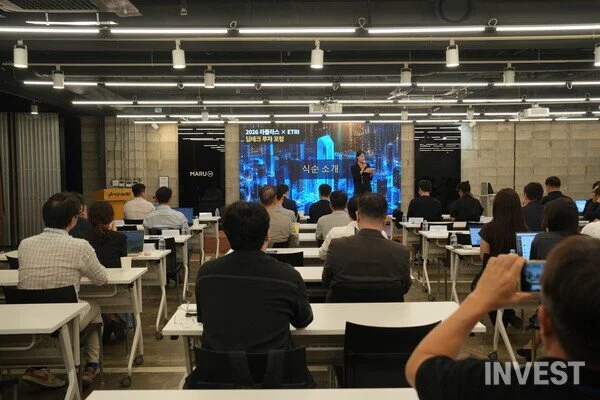
In this forum, the role of investment firms in connecting technologies in the early R&D stage to business models capable of market entry was emphasized. Since the deep tech field involves long R&D periods and requires facility investment, it was explained that the capabilities of specialized investment firms that can judge both technological differentiation and commercialization difficulty are important.
Laplace Partners explained that they have been pursuing a portfolio value-up strategy that converts early technologies into business models from this perspective. The case of Hogreen Air, a hydrogen technology-based company that achieved actual investment following participation in a past forum, was also introduced. The organizers structured the forum to explain the technical characteristics and business applicability of the presenting companies to investment analysts, so that this forum could go beyond a simple Investor Relations (IR) session and lead to substantial investment.
At the scene, analysts from 16 VCs and asset management companies, including Won Asset Management, KC Investment Partners, The Invention Lab, Hanwha Investment & Securities, and Synergy IB Investment, attended. The analysts recorded technical specifications, patent barriers, and target market sizes while comparing laptops with presentation materials. In the Q&A session, questions arose regarding specific business indicators such as the possibility of cost reduction compared to alternative technologies, compatibility with existing infrastructure, and commercialization and mass production schedules. In particular, while the power consumption and cost burden of Artificial Intelligence (AI) infrastructure were mentioned as major challenges in the industry, interest was also confirmed in technologies applicable to the actual demand market, such as edge device and low-power chip design.
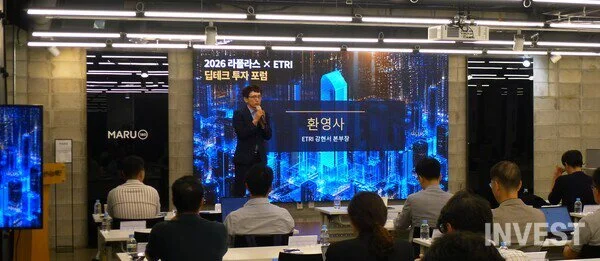
The collaboration structure with ETRI was also mentioned as a factor supporting the technology verification and commercialization foundation of the participating companies. In the welcoming remarks, Kang Hyeon-seo, head of the ETRI division, explained how the infrastructure and technology diffusion programs held by national research institutes connect with the private startup ecosystem. Kang said, "The linkage with ETRI, such as the use of high-priced measurement equipment, test certification, and standardization support that is difficult for deep tech companies to handle independently, acts as a practical means to significantly shorten the commercialization period."
The startup teams and institutional officials attending the scene agreed that technological competitiveness can be enhanced when the core technologies of public research institutes are combined with the market responsiveness of private startups.
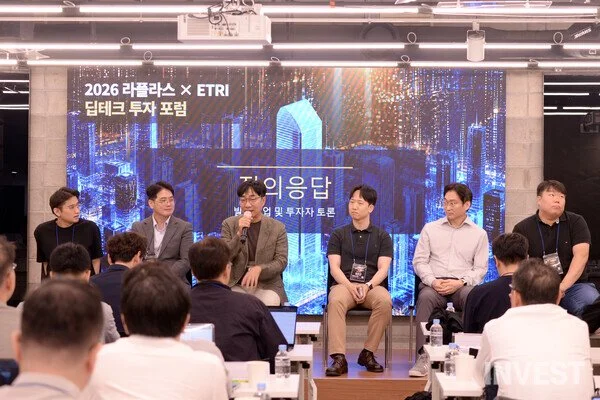
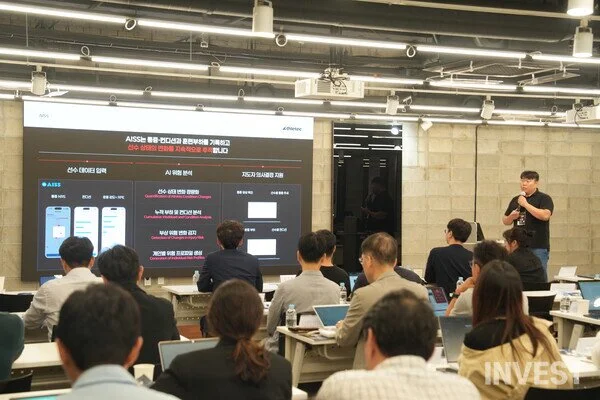
In the pitching session, the commercialization plans and technology application cases of six companies targeting industrial field demand were introduced.
Nano Solution, which possesses independent technology for the entire Carbon Nanotube (CNT) process, presented its capabilities in dispersion and coating combinations tailored to customer requirements beyond material synthesis. The company also revealed its roadmap for a KOSDAQ technology special listing following its KONEX listing.
The retail vision AI company May-I introduced a model that collects and analyzes visitor behavior data in offline spaces by utilizing existing closed-circuit television (CCTV) infrastructure. It is a software-centered approach that reduces the burden of introducing new hardware.
Hydrogen mobility company Hogreen Air presented a plan to extend drone flight times up to 14 hours based on an integrated power pack design that handles liquid hydrogen at minus 253 degrees Celsius. They also announced plans to expand their business scope into the hydrogen power generation infrastructure market.
Semunite proposed a low-power, low-cost on-device AI semiconductor solution tailored for edge and Internet of Things (IoT) appliance environments instead of general-purpose ultra-high-performance chipsets. Joint analysis company Athlytech, which aims to prevent injuries, and new drug molecular design platform company HITS also introduced digital solutions aimed at application in industrial sites.
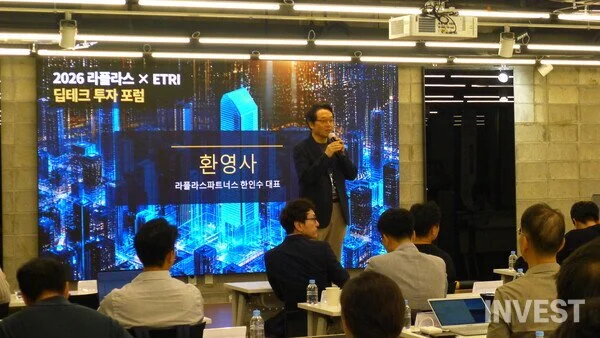
Han In-su, CEO of Laplace Partners, stated in his opening remarks, "IR is merely the starting point for company introductions, and true results arise from the close connections that follow." He added, "The essential goal of this forum is to translate complex deep tech technologies into business language that the market and investors can accurately understand, and to create touchpoints that lead to actual follow-up investment reviews and business cooperation."
[Field Diagnosis] Conditions for Deep Tech Commercialization: Moving Beyond Technical Superiority to Mass Production, Demonstration, and Economic Feasibility
This event was not limited to listing the excellence of technologies, but served as a venue to discuss the conditions required for laboratory-stage technologies to be applied as products and components in the actual market. Participating companies focused their presentations on ways to respond to industrial site requirements, such as manufacturing unit costs, connectivity with existing infrastructure, and low-power operation.
Investment firm analysts also focused on distinguishing the gems from the stones through questions regarding mass production feasibility, demonstration data, and commercialization schedules, rather than comprehensive explanations of future growth potential. As the technology diffusion function of public research institutes and the investment review of private VCs converged in one space, it was a scene where the survival tasks of deep tech startups were revealed more concretely.
For early-stage deep tech companies, this forum demonstrated that they must present economic feasibility from a customer's perspective in addition to technical performance. In the process of focusing on the excellence of papers and patent indicators, deep tech companies may fail to sufficiently review the mass production yield, unit cost suitability, and customer switching costs required by the actual market. Accordingly, rather than merely explaining the complex operating principles of their technology, early-stage companies need to present, with specific figures and evidence, how much their solutions can reduce the time and costs of the adopting companies.
The networking time allocated after the IR must not remain a simple venue for exchanging business cards. From the perspective of early-stage companies, it is necessary to hear opinions from investment firms and public research institute officials regarding technology verification standards and regulatory barriers, and to utilize these for follow-up fundraising and pursuing Proof of Concept (PoC).
![[Field Report] 2026 Laplace × ETRI Deep Tech Investment Forum: 16 VCs and Asset Managers…](/storage/investnews-global/2026/09/edec66e6-250c-41a5-b9a3-aab2d0333ac6-e58ed7b7-thumb.webp)
![[Field Report] 2026 Agri-Food Startup Contest Finals: From Robot Vertical Farms to Freshness…](/storage/investnews-global/2026/09/40b735aa-f551-4af6-a127-9d7227b1521c-a20cf627-thumb.webp)
Comments 0
Comments are currently disabled.