
[Field Report] 2026 Agri-Food Startup Contest Finals: From Robot Vertical Farms to Freshness Packaging... 11 Agri-Food Startup Teams Reach Finals
The finals of the 2026 Agri-Food Startup Contest were held on the 16th at the LOTTE R&D Center…
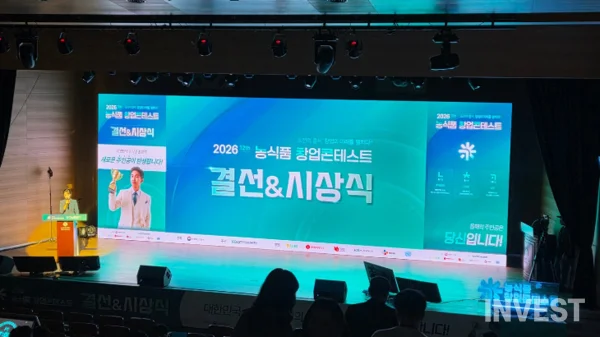
"What is the initial setup cost?" "To what stage has overseas business progressed?"
At the finals of the '2026 Agri-Food Startup Contest' held on the 16th at Charlotte Hall of the LOTTE R&D Center in Gangseo-gu, Seoul, questions from judges followed every presentation by participating companies, verifying revenue structures and market entry possibilities. Companies explained their business models by presenting technological differentiation, costs, and methods for securing sales channels.
A total of 521 teams applied for this year's contest, hosted by the Ministry of Agriculture, Food and Rural Affairs and organized by the Korea Agriculture Technology Promotion Agency. After preliminary and main rounds, 11 teams advanced to the finals: △Banseok Industry △The Fresh More △Meta DX △Rowain △Agro Solution Korea △Awesome Bread △ITA DX △K-Bio Gateway △Duri Company △HUMILL △Alttoo.
The 11 teams presented their business models for 7 minutes and then answered questions from judges for 8 minutes. It was a venue to demonstrate not only technological competitiveness but also whether they could be applied to actual agri-food sites to generate profit within a limited time.
Presenting solutions for agri-food field problems
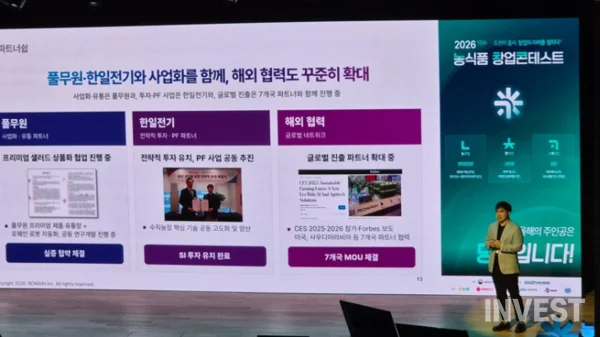
Rowain introduced 'Intellifarm', a vertical farm system based on autonomous mobile robots. The method involves robots moving cultivation towers planted with crops between the work area and the cultivation area, reducing the aisles people walk through and increasing space utilization. Rowain emphasized that this can reduce the spatial constraints and labor burden of vertical farms.
Agro Solution Korea presented 'Four Season Berry', a vertical farm solution that reduces the influence of seasons and climate to produce strawberries year-round. In overseas markets, they are applying a business model that comprehensively provides facilities suitable for the local area, cultivation technology, and operational know-how.
Domestically, they proposed a plan to link farms with bakery cafes to process and sell directly produced strawberries as desserts. Rather than competing in price with general facility-cultivated strawberries, their strategy is to secure new sales channels and increase added value by combining food service and processing businesses.
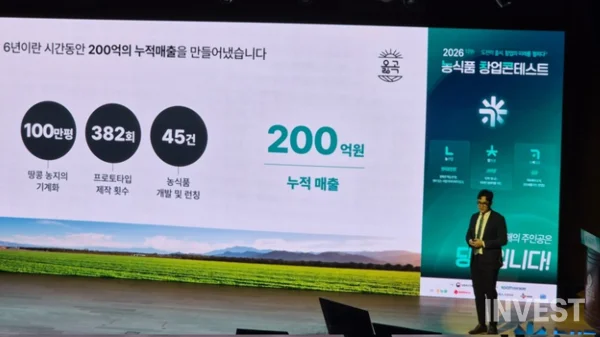
Banseok Industry introduced the process of expanding its business from manufacturing peanut agricultural machinery to a food brand. While the company's production increased through the distribution of agricultural machinery, they faced the problem of accumulating inventory due to insufficient sales channels, so they launched the peanut butter brand 'Olggok' to solve this. Utilizing the production area network built through the existing agricultural machinery business, they are stably procuring raw materials and promoting the development of various products based on this.
The Fresh More promoted packaging technology that reduces waste loss occurring during the distribution process of agricultural, livestock, and fishery products. The method applies functional additives and coating technology to existing labeling and packaging materials to extend the freshness duration. Following consumer stickers, they plan to expand their business scope to functional shipping containers used by local distribution centers and farms.
As each company presented field problems and solutions, judges verified the feasibility of the business models. They examined whether the presented ideas could lead to sustainable profits by asking about initial investment costs, payback periods, domestic and overseas sales channels, and methods for verifying technological effects.
Product explanations and startup consultations outside the stage
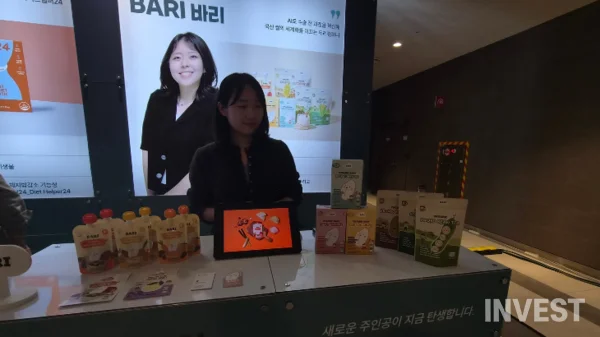
Verification of business models continued outside the presentation hall. During breaks between presentations, attendees visited the exhibition booths of the finalist companies to examine products and prototypes. Company representatives explained product functions and usage methods not covered in the presentations and answered questions raised on-site.
At the Duri Company booth, which exhibited infant food made from domestic rice, inquiries regarding product ingredients, manufacturing processes, and safety continued. A Duri Company official said, "As it is a product for infants, attendees showed great interest in safety, such as ingredients and the manufacturing process."
The event operated not only to evaluate the business viability of the finalist companies but also as a place to guide those preparing for startups on how to commercialize their businesses. At the startup consultation booth set up in one corner of the exhibition space, prospective entrepreneurs received consultations on how to concretize their ideas and government support projects that can be utilized in the early stages.
Koo Woong-mo, CEO of SBE Lab, who handled the consultations, reported that prospective entrepreneurs showed interest in startup preparation procedures and support policies. CEO Koo explained, "They were mainly curious about where to start the startup process and which support projects they could utilize in the early stages," adding, "I guided them on how to concretize ideas and receive advice and mentoring in a situation where manpower and resources are lacking."
![[Field Report] 2026 Laplace × ETRI Deep Tech Investment Forum: 16 VCs and Asset Managers…](/storage/investnews-global/2026/09/edec66e6-250c-41a5-b9a3-aab2d0333ac6-e58ed7b7-thumb.webp)
Comments 0
Comments are currently disabled.