SK hynix to announce third-quarter results and shareholder return policy
SK hynix is scheduled to announce its third-quarter earnings on the 28th, with investors closely watching for potential shareholder return policies and how the results align with global AI profitability trends.
SK hynix will announce its third-quarter earnings on the morning of the 28th, with investors focusing on potential shareholder returns and AI profitability. While the company plans to return over 50% of cumulative free cash flow generated from 2025 to 2027, historical data shows stock price fluctuations have remained within 3% in six of the last 11 announcement instances.
SK hynix will announce its third-quarter earnings on the morning of the 28th. Among domestic stock investors, there is significant skepticism that even if strong results are reported, the stock price may not react positively.
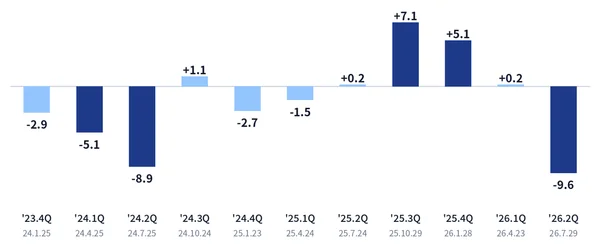
This sentiment is supported by data from the Data Analysis, Retrieval and Transfer System (DART), which shows the stock price movements on the 11 earnings announcement dates since 2024. In 6 of those 11 instances, the price fluctuations remained within 3%, indicating generally muted reactions on announcement days.
However, there have been days of significant volatility. On 5 occasions, the price moved by more than 5%. Among these, the stock plummeted on 3 occasions (April and July 2024, and July this year), while it surged on 2 occasions (October 2025 and January this year) by 7.1% and 5.1%, respectively.
Two major variables are expected to drive SK hynix's stock price on the 28th. The first is whether the earnings meet market expectations, and the second is the shareholder return policy that the company has promised to announce during the third-quarter earnings briefing.
In the early hours of the 29th, Microsoft and Alphabet are also scheduled to release their earnings. The stock price reaction on the 28th is expected to be determined by how these two companies answer the question of whether AI is becoming profitable.
SK hynix stock price remains mostly muted despite 11 earnings announcements
SK hynix discloses preliminary results at 9:00 a.m., before the market opens each quarter. Consequently, the stock price on the announcement day represents the market's initial reaction to the earnings. An analysis was conducted on the 11 announcement dates from January 2024, when the company first reported operating profits returning to the black, through July of this year.
The stock price on these dates was generally stagnant. In 6 of the 11 instances, the fluctuation was within 3%, with an average total fluctuation rate of -1.5%. However, the -9.6% drop on July 29 of this year is difficult to view solely as a reaction to earnings, as the entire market was shaken; both SK hynix and Samsung Electronics plummeted by 13–15% the previous day, and leveraged ETFs for both stocks fell by nearly 30% in a single day due to related issues.
Samsung Electronics also shows a disconnect between strong earnings and stock reaction
Unlike SK hynix, Samsung Electronics discloses preliminary revenue and operating profit immediately after the quarter ends and then announces detailed results several weeks later. Based on the preliminary earnings announcement dates, the stock price fell on 8 out of 12 occasions. However, the magnitude of the fluctuations was smaller than those of SK hynix.
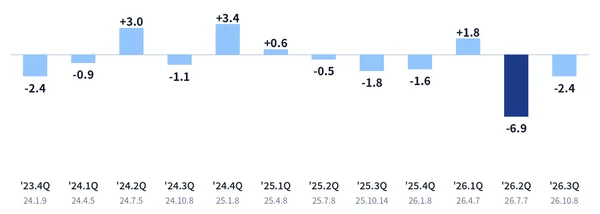
Excluding July 7 (-6.9%), the price fluctuations were within 3.4% for all 11 instances. Even on October 8, when quarterly operating profit first exceeded 100 trillion won, the stock price fell by 2.4%.
Notably, on July 7, the stock price fell by 6.9% despite operating profit increasing by 56% from the previous quarter to 89.4 trillion won. For Samsung Electronics shareholders, such results could lead to claims that the stock price reaction is disappointing despite record-breaking performance.
Watch Point 1: 'Additional shareholder returns' to be announced alongside earnings
Earnings are not the only thing being announced on the 28th. In a public disclosure on August 19, SK hynix stated, "The specific scale and method of additional returns will be announced at the time of the third-quarter earnings announcement following a resolution by the Board of Directors." This means the company will announce how much more it will engage in "shareholder returns"—returning a portion of its earnings to shareholders—on this day. This provides an additional catalyst for the stock price beyond just the earnings figures.
The benchmark for shareholder returns is Free Cash Flow (FCF). The company disclosed that, assuming it meets its financial soundness targets, it "plans to return more than 50% of the cumulative free cash flow generated during the policy period (2025–2027)."
Free cash flow is the money remaining after subtracting capital expenditures for facilities and equipment from the cash generated through operating activities. This represents a promise to return more than half of the money remaining over a three-year period to shareholders. Return methods include dividends (distributing cash) and share buybacks and cancellations (buying and retiring own shares).
How much capacity remains for additional returns? This was calculated based on the cash flow statements in the 2025 business report and the first half report of this year. The 2025 free cash flow was 24.79 trillion won (53.37 trillion won - 28.58 trillion won), and the first half of this year was 72.75 trillion won (91.74 trillion won - 18.99 trillion won). Capital expenditures included amounts spent on tangible assets like plants and equipment, as well as intangible assets such as patents and software.
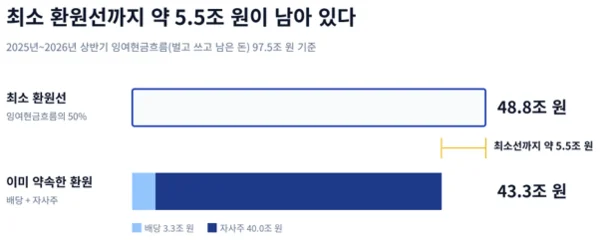
Looking only at the first half, the difference is not large at 5.5 trillion won. However, if a significant amount of money remains in the third quarter, the situation changes. Assuming the third-quarter free cash flow is between 30 trillion and 60 trillion won—based on the first-half quarterly average of approximately 36 trillion won—the difference grows to between 20 trillion and 35 trillion won. The market is likely to judge the figures the company presents on the 28th by comparing them to this range.
However, this calculation should not be viewed as a definitive standard. Since the return standard promised by the company is a cumulative amount over three years until 2027, there is no obligation to fulfill it all at once this time. The exact method the company uses to calculate free cash flow has also not been disclosed.
While it is difficult to determine the scale of additional returns, shareholder return announcements have acted as variables that move stock prices in the past. When SK hynix announced a 40 trillion won share buyback and cancellation after the market closed on August 19, its stock price rose sharply in after-hours trading and jumped 12.7% the following day. On the same day, the KOSPI rose in the 5% range, but SK hynix's increase was more than double that.
Watchpoint ② In the early morning of the following day, the 'AI Profitability' that Big Tech will answer
Following SK hynix's earnings announcement, the earnings of Microsoft (MS) and Alphabet in the United States will follow. Since both companies will announce after the US market closes on the 28th, it will be the early morning of the 29th in Korean time. These two companies are the ones spending the most money on AI data centers, and SK hynix's memory is included in the AI semiconductors (GPUs, TPUs, etc.) that they purchase.
It is virtually certain that the data center investments of these two companies will increase further. MS's capital expenditure for the April-June period this year was 35.8 billion dollars, more than double from a year ago. Alphabet announced a 'capital expenditure of approximately 75 billion dollars for 2025' last February, but actually spent 91.4 billion dollars. In February this year, they presented annual capital expenditure as 175 billion to 185 billion dollars, and executed 80.6 billion dollars in the first half of the year alone.
Because of this, the market's question is now focused on 'are they earning as much as they spend' rather than 'how much more will they spend.' The question of 'when can the invested money be recovered' is in the same context.
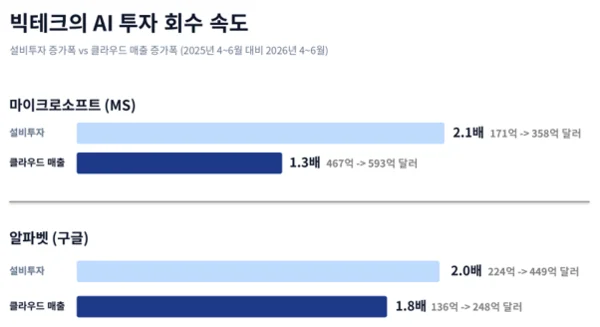
Companies have begun to answer this question with numbers. MS's cloud revenue growth rate accelerated from 21–23% in 2024 to 26–29% in the most recent year. Among this, the revenue growth rate of Azure, its data center business, was 43% in the April-June period. MS's capital expenditure increased 2.1 times, significantly exceeding the 1.3 times increase in cloud revenue.
Google Cloud's revenue for the April-June period this year was 24.8 billion dollars, an 82% increase from a year ago, and its operating profit was 8.8 billion dollars, which tripled. Over one year, Google's cloud revenue increased 1.8 times, approaching the 2.0 times increase in capital expenditure.
While revenue is increasing, investment expenditures are also rising rapidly, resulting in a situation where the cash remaining for companies is decreasing. Alphabet's free cash flow for the April-June period was -5.9 billion dollars. This means the money spent on capital expenditure was greater than the cash earned from operations. MS's free cash flow for the same period was also 19.6 billion dollars, a decrease from 25.6 billion dollars a year ago.
This is the point that investors want to confirm in the early morning of the 29th. Rather than whether they will raise capital expenditure forecasts again, attention is focused on whether cloud revenue and operating profit are increasing in line with investment expenditures.
From the scale of shareholder returns to AI demand and profitability, August 28–29
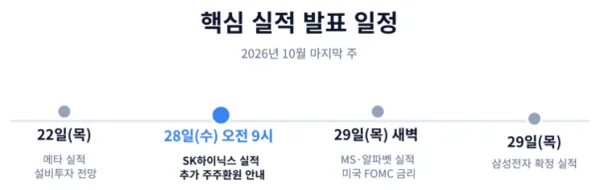
SK hynix announced that it will release its third-quarter management results through a conference call at 9:00 AM on the 28th. In the early morning of the next day, the earnings announcements of MS and Alphabet, as well as the interest rate decision by the US Federal Open Market Committee (FOMC), will follow.
The first number to check on the 28th is the scale of additional shareholder returns. Since the return standard is a cumulative amount until 2027, there is no obligation to fill the minimum return line all at once this time, but the market is likely to compare the announced scale with expectations. It is also necessary to look at whether they choose dividends or share buybacks, and how the company calculates the free cash flow it uses as a standard for returns. As the domestic stock market, including SK hynix, is showing weakness after its late September peak, an announcement that falls short of expectations could be a burden on the stock price trend.
The answer to the question the market continues to ask, 'is AI demand continuing,' will come during the conference call. The key is whether HBM prices and volumes for next year, capital expenditure plans, and the persistence of memory shortages are presented with specific numbers.
In the earnings announcements of MS and Alphabet in the early morning of the 29th, attention is expected to be focused on changes in the profitability of the cloud business and free cash flow rather than capital expenditure forecasts. As the FOMC results are also scheduled, the last week of October is expected to be an important week for investors.

Comments 0
Comments are currently disabled.