
Five South Korean Startups Named to NVIDIA Inception Grand Challenge 2026 Asia-Pacific Top 10
AIM Intelligence, Tnaps, Omelet, Filer and WIM said they were selected for the NVIDIA Inception Grand Challenge 2026 Asia-Pacific final top 10, held in Singapore on September 22. The startups presented work in AI security, industrial decision-making, live-stream ad suitability and robot control.
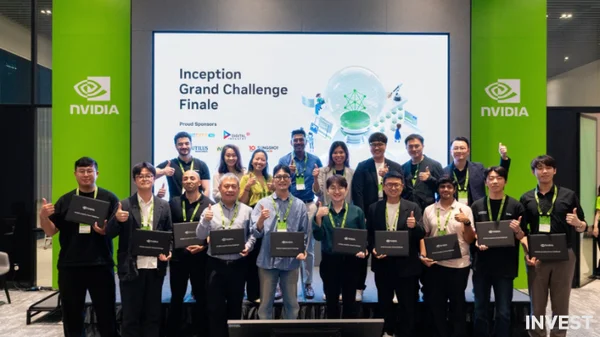
Five South Korean startups — AIM Intelligence, Tnaps, Omelet, Filer and WIM — said they were selected for the Asia-Pacific final top 10 of the NVIDIA Inception Grand Challenge 2026. The final was held in Singapore on September 22.
The competition is for growth-stage AI startups in the Asia-Pacific region and is organized by NVIDIA. It is designed around solving real industrial challenges presented by companies, with opportunities to pursue pilot projects and on-site adoption. Applications closed on July 5 this year. The field was narrowed from 500 companies to 80, then to 40. NVIDIA said 14 of the 40 teams that passed the preliminary round were from South Korea, working in areas including physical AI, robotics, agentic AI, AI security, vision AI and edge AI.
The top 10 companies receive exposure at regional innovation events, introductions to partner companies and technical support, and are prioritized for consideration for the Enterprise Readiness Program. Each startup may receive GPU credits worth up to $30,000 and market-entry support. They will also appear at SLINGSHOT, a global startup pitching competition held October 27-29.
Nebius special award and audience vote go to AIM Intelligence, which presented AI security from vulnerability testing to real-time control
AIM Intelligence received a special award from AI cloud company Nebius at the final and was also named the top company in the audience vote.
In its presentation, the company said AI is moving beyond generating answers to making decisions and acting within enterprise systems and physical environments. It argued that this shift calls for an end-to-end security and control framework covering generative AI, agentic AI and physical AI.
Its proposed solution, AIM Control Loop, is a cycle of finding AI vulnerabilities, controlling them in operating environments, and then conducting further attack tests to strengthen defenses. The company said the process is intended to identify and control risks continuously rather than stop at a one-time safety assessment.
At the South Korean semifinals in August, AIM Intelligence Chief Technology Officer Park Ha-eon said: “As AI evolves beyond a tool that answers questions on a screen into an actor that directly operates in enterprise systems and the physical world, the key question is changing from ‘What can AI do?’ to ‘Who will control AI?’” Park said the company aimed to become a global AI security and control company spanning generative, agentic and physical AI.
Founded in 2024, AIM Intelligence supplies an AI security platform designed for situations in which AI agents make decisions, call APIs and act without human supervision. An API call lets AI use another program’s functions to perform a task.
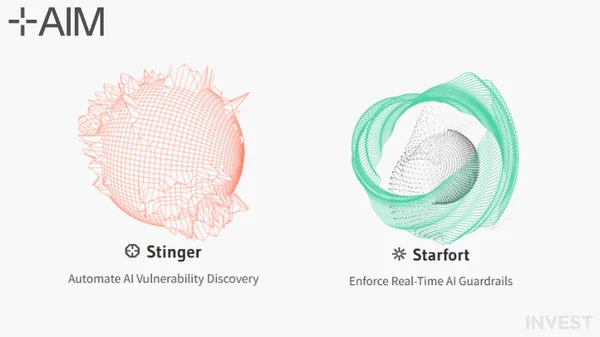
Its core products are Stinger and Starport. Stinger automatically generates attack scenarios to find AI vulnerabilities. The red-teaming tool tests systems from an attacker’s perspective and supports inputs including text, images, audio, video and physical AI. Starport is a security solution that blocks risks in real time while AI is operating. It detects sensitive data such as personal information and trade secrets, and controls abnormal API calls by autonomous agents.
AI security startup Tnaps reaches the final little over a year after its founding
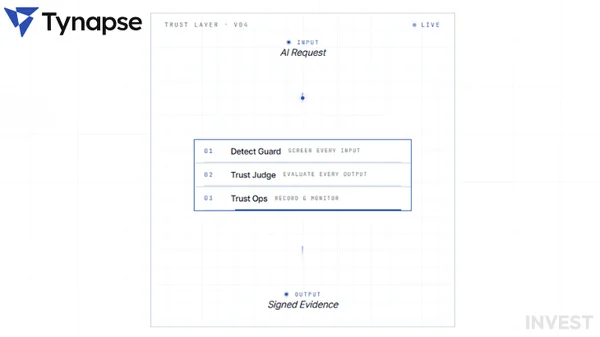
AI security startup Tnaps, founded in 2025, reached the final little over a year after its establishment. It presented “decision trust infrastructure” that checks the actions of AI agents before they are carried out.
The technology assesses whether an agent’s decisions comply with company policies and whether carrying them out would pose risks, then allows or blocks the task. It also records the grounds for each decision and the policies applied so they can be used in later audits.
Tnaps is building a dedicated execution environment to avoid delays in verification for large-scale enterprise services. Its system applies NVIDIA Hopper-series GPUs, TensorRT-LLM inference software and FP8 computing to verify AI decisions and determine whether they can be executed.
In the financial sector, Tnaps has worked with KB Kookmin Bank on a project to verify the reliability of AI financial counseling. The collaboration received the Financial Services Commission chairman’s Collaboration Award of the Year in June. Tnaps is currently conducting a proof of concept with KB Kookmin Bank and discussing adoption with at least three large financial institutions.
The company said it raised 4.5 billion won in a seed round in May, with participation from Mirae Asset Venture Investment, Mirae Asset Capital, Murex Partners and Kakao Ventures. Jo Jin-hwan, a director at Mirae Asset Venture Investment who led the round, said: “For AI to operate safely in real industrial environments, it needs not only technology but also domain understanding and execution experience. We judged Tnaps to be a team with deep field experience in finance and security as well as global-level AI capabilities, and one that can solve the AI reliability problem in practice, so we decided to invest.”
Omelet applies AI to industrial decisions, from deliveries to cargo loading
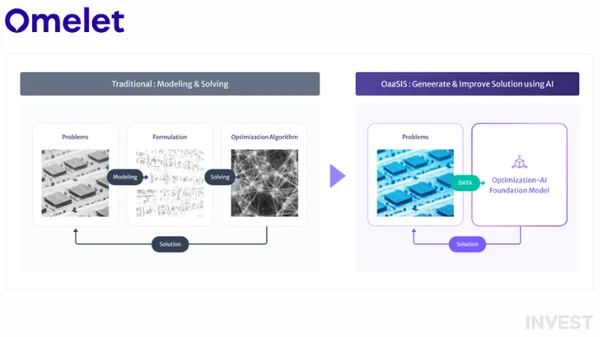
Omelet introduced “operational intelligence” (OI), which applies AI to operating decisions on industrial sites. CEO Park Jin-gyu said the company aims to build reusable assets from solutions to complex problems such as delivery routes, work schedules, cargo loading and inventory management. The approach uses AI agents to produce plans that reflect each customer’s operating conditions.
Park and Chief Technology Officer Kwon Chang-hyeon co-founded Omelet in 2023 as a KAIST faculty startup. The company combines mathematical optimization with AI to find efficient plans under multiple constraints. Its main product, OaaSIS, uses data and constraints such as delivery locations, vehicles, time and volume to generate operating plans, including delivery routes and resource allocation. It focuses on calculating which choices to carry out, beyond predicting conditions.
Omelet said it is working on 18 projects across seven industries: logistics, retail, healthcare, manufacturing, mobility, defense and entertainment. It has supplied technology for GS Retail’s delivery route planning and Hyundai Glovis’s ship cargo loading. The company said its projects have cut logistics costs by more than 20% and raised ship loading efficiency above 90%.
Park said: “We will turn the problem-solving capabilities gained from projects into assets, develop those assets into products that more customers can use, and connect better, faster industrial decisions to actual operations.”
Filer analyzes live footage to assess advertising suitability

Filer unveiled technology to assess advertising suitability during connected TV (CTV) live broadcasts, in collaboration with a global free ad-supported streaming television (FAST) service provider. Its video-understanding AI analyzes broadcast images, dialogue and sound in real time to determine whether a scene is suitable for advertising. The company has adapted video analysis previously used for video-on-demand content to live broadcasts.
Unexpected events in live broadcasts can cause ads to appear alongside unsuitable scenes, limiting ad sales. Filer said it addresses this by analyzing the context of individual scenes rather than an entire broadcast. It said that evaluating the safety of individual scenes in live news can identify segments where advertising can be sold.
Founded in 2021, Filer develops video-understanding AI that analyzes video, audio and text together. Its main solution, AiD, detects sensitive content in video-based advertising environments and helps ensure ads are not shown alongside such content. The multimodal AI classifies sensitive content by analyzing visual information and text together rather than checking only for specific words. Advertisers can set filtering criteria for each campaign to manage which content carries their ads.
In a Nongshim campaign for KPop Demon Hunters disclosed by NVIDIA, the share of spending on content deemed unsuitable for the brand fell to 4.67% within a month after AiD was applied, from a comparison baseline of 19.3%. During that period, AiD checked more than 2 million videos for unsafe placements.
WIM presents a “physical AI Android” for robot development
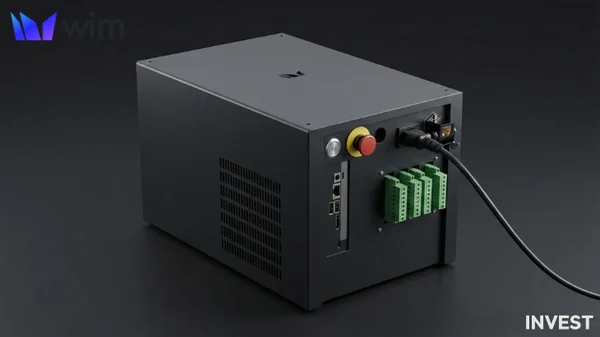
WIM was one of three robotics companies among the challenge’s final award winners and placed second in the audience vote. It presented “Android for physical AI” as its business direction, saying it aims to let robot developers focus on AI development without having to build basic control functions from scratch, just as app developers do not build operating systems themselves.
WIM said the development of control systems needed to apply AI models to robots is a burden. Moving a robot requires calculating joint positions and movements, compensating for gravity and friction, and controlling motors to meet targets. The company said it would integrate these functions to reduce the need for developers to repeatedly build control systems.
The product is WIM Robot Controller, which performs AI inference and real-time motor control on a single NVIDIA Jetson platform to translate AI decisions into robot movement. It can also connect to robot hardware made by other manufacturers.
WIM also offers PLEM robot-control software, the six-axis articulated robot solution AI-MANIPULATOR, and made-to-order industrial printed circuit boards (PCBs). PLEM integrates basic functions such as motor control so developers can apply AI models. AI-MANIPULATOR plans robot movements using neural networks to carry out precision work in industrial settings. The PCBs are designed and produced to meet customers’ requirements for communications methods, input and output channels, and operating voltage.
Covers Post-IPO for INVEST NEWS GLOBAL.
![[Series] S Innovations, an AMR operation automation company, attracts 3 billion won in Pre-A investment to advance technology](/storage/investnews-global/2026/10/5731c1d0-0893-4fa7-83f5-086a1e6f5457-54ca211e-thumb.webp)
![[Series] Cooling Solution Startup Sinseongo Secures Pre-A Investment... Aiming for 2030 IPO with AI Data Center Growth](/storage/investnews-global/2026/10/bbfa01f3-e11d-4421-aa09-4132732afc3a-3266bb0b-thumb.webp)
![[Series] Non-invasive CGM Startup Apollon Secures 5 billion won... To be Invested in US Clinical Trials and FDA Approval](/storage/investnews-global/2026/10/cd5b75ee-1d3f-42d5-ad3f-7ff5dcb198d9-e07e62ae-thumb.webp)
Comments 0
Comments are currently disabled.