Yeonggwang sees high subscription ratio despite low institutional commitment
Shipbuilding and plant equipment maker Yeonggwang recorded a 684.73-to-1 competition ratio in its general public subscription, driven by expectations of increased shipbuilding orders and expansion into next-generation energy markets. However, institutional investors' commitment to mandatory holding periods was notably low at just 0.87%.
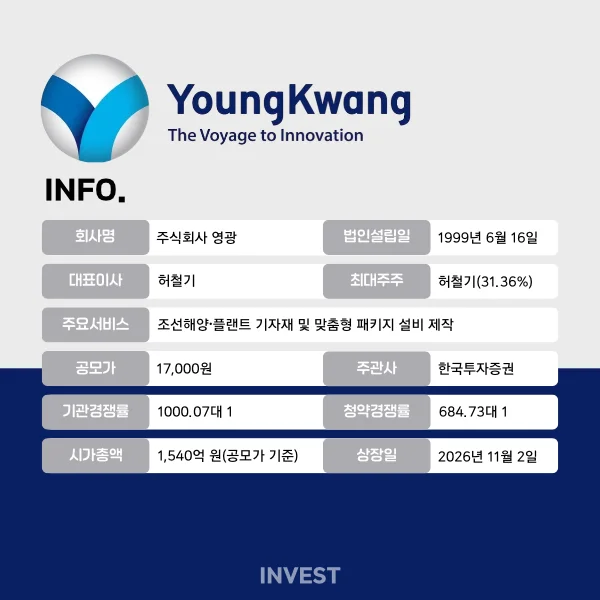
Yeonggwang recorded a 684.73-to-1 competition ratio for its general public subscription, with the offering price finalized at 17,000 won. However, the mandatory holding commitment ratio from institutional investors fell to just 0.87% during the demand forecast held from the 13th to the 19th.
Yeonggwang, a shipbuilding and plant equipment company, recorded a high competition ratio in its general public subscription following its institutional demand forecast. While expectations are rising regarding the expansion of shipbuilding orders and entry into next-generation energy markets, a gap was observed between investment demand and the intention for long-term holding, as the mandatory holding commitment ratio from institutional investors fell below 1%.
According to the investment banking (IB) industry on the 23rd, Yeonggwang recorded a competition ratio of 684.73-to-1 for the general investor public subscription. The resulting deposit amount is approximately 3.2886 trillion won. The total public offering consists of 2.26 million new shares, with 565,000 shares, or 25%, allocated to general investors.
During the demand forecast held from the 13th to the 19th, 2,276 institutions participated, resulting in a competition ratio of 1,000.07-to-1 with 1.7 billion shares requested. As 97.75% of the total requested volume suggested prices at or above the top of the target band (14,000–17,000 won), the offering price was finalized at 17,000 won.
In contrast, the institutional investors' mandatory holding commitment ratio was only 0.87% based on the requested quantity. Due to this low institutional commitment, the lead manager, Korea Investment & Securities, must acquire an additional 22,600 shares, representing 1% of the public offering, and hold them for at least six months from the listing date.
According to the registration statement, the volume of shares available for distribution immediately after listing is 2,870,800 shares, or 31.70% of the total planned shares. While the 5,604,240 shares held by the largest shareholder and related parties are subject to a mandatory holding period of two and a half years, the 601,800 shares held by the existing investor, BK Shipbuilding Investment Association, can be sold immediately after listing. This volume accounts for 6.74% of the total shares after the offering and may act as selling pressure in the early stages of listing.
Yeonggwang is scheduled to list on the KOSDAQ market on the 2nd of next month, following the deposit payment and refund process on the 27th. The expected market capitalization based on the offering price is approximately 154 billion won.
Yeonggwang Business Analysis
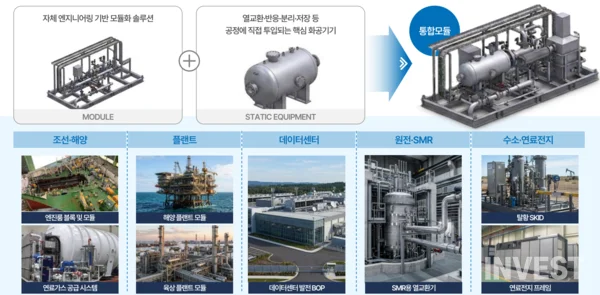
Established in 1999, Yeonggwang is a shipbuilding and plant equipment company that manufactures and supplies marine structures and industrial equipment. It maintains two main business pillars, shipbuilding/marine and plant, and promotes its modularization technology—which performs everything from design to manufacturing and assembly—as its core competitiveness.
The primary business is the shipbuilding and marine sector. The company supplies engine room modules, various units, and hull blocks used in ship engine rooms. Rather than having individual parts assembled at a shipyard, Yeonggwang pre-manufactures major equipment for delivery, which serves to increase ship construction efficiency. While benefits are expected from the expansion of shipbuilding orders, performance is structured to depend on the construction schedules and order volumes of major shipbuilders.
The plant sector serves as the axis for business diversification. The company manufactures industrial equipment such as pressure vessels and heat exchangers, supplying them in modular forms that combine multiple pieces of equipment. This expands the manufacturing technology accumulated in the shipbuilding field into the plant sector; the revenue portion for the plant sector rose to 32.34% in the first half of this year, approximately doubling compared to 16.22% in 2023.
Yeonggwang's business follows an order-based structure where products are produced according to the requirements of each customer. As of the end of the first half of this year, the order backlog stands at approximately 202.2 billion won, securing work that can support future revenue. On the other hand, the top two customers account for 63.07% of revenue, indicating a high dependency on the ordering policies and volume allocations of major clients. Beyond the shipbuilding and plant industry conditions, fluctuations in raw material prices and outsourcing costs also influence profitability.
The company has presented hydrogen/fuel cells, carbon capture, data center power equipment, and small modular reactors (SMR) as next-generation growth engines. This plan involves expanding the existing business structure, centered on shipbuilding and plants, into the high-value-added energy equipment field. However, since many of the new businesses remain at the stage of customer registration or quotation/negotiation, time will be required before they lead to actual orders and revenue.
Yeonggwang Performance and Use of Funds Plan
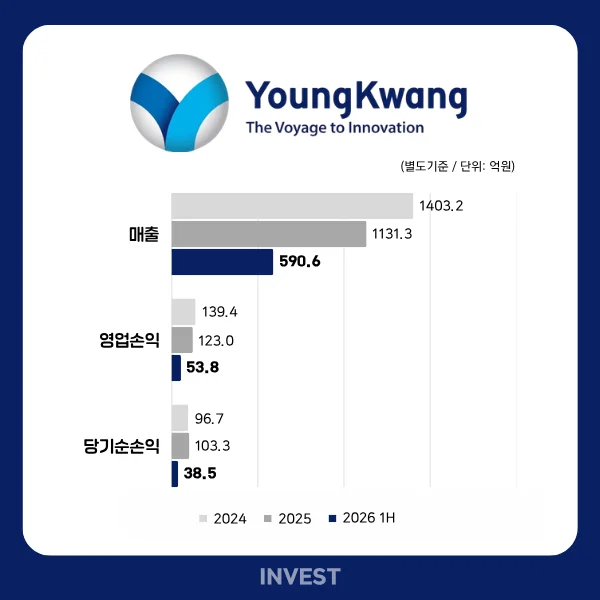
Yeonggwang has maintained a certain level of profitability despite recent decreases in revenue. While 2025 revenue was 113.1 billion won, a 19.4% decrease from the previous year, operating profit only decreased by 11.8% to 12.3 billion won. As a result, the operating profit margin rose to 10.9% in 2025 from 9.9% in 2024.
The slowdown in growth continued in the first half of this year. Revenue was 59.1 billion won, a 4.4% decrease compared to the same period last year, and operating profit was 5.4 billion won, recording an operating profit margin of 9.1%. As the high-profit hull block volume in the shipbuilding and marine sector concluded, the recovery in profitability in the plant sector partially offset this. However, since the improvement in the plant sector's profit margin reflects the effect of increased contract amounts from existing projects, whether this improvement can be sustained remains to be seen.
While the financial structure is improving, the burden of borrowings remains high. As of the end of the first half of this year, the debt ratio was 242.2%, significantly lower than the 456.1% recorded at the end of last year. This was influenced by the conversion of convertible preferred shares into common stock and an increase in retained earnings. Total borrowings amount to 60.6 billion won, of which 49.3 billion won is debt from sale-and-leaseback transactions. Interest expenses also reach about one-third of the operating profit, meaning the burden of financial costs persists.
The operating cash flow, which recorded a net inflow of 24.8 billion won last year, turned into a net outflow of 1.3 billion won in the first half of this year. Due to the nature of the business, where revenue is recognized according to construction progress, an increase in contract assets has caused a burden in cash collection.
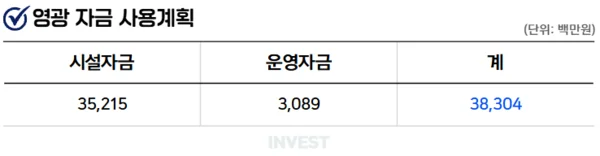
Yeonggwang plans to invest the approximately 38.3 billion won in net proceeds raised through this listing into facility investment and research and development.
The largest portion is allocated to facility investment. A total of 35.2 billion won has been assigned, with 26 billion won to be used for securing land to integrate the Geoje and Goseong plants. The plan is to unify production facilities to reduce rent and logistics costs and to secure LNG carrier block volumes that could not be ordered due to existing facility constraints. Funds will also be invested in introducing transportation equipment, painting/construction equipment, and laser welding equipment, as well as establishing a local subsidiary in Bulgaria.
The remaining 3.1 billion won will be used for research and development of eco-friendly ship equipment. The company plans to build test beds to verify the performance of eco-friendly fuel supply devices to link them with new orders. The public offering funds are expected to be executed in stages during 2027–2028, and the target site for the integrated plant, a core investment destination, has not yet been finalized in terms of purchase target and timing.
Covers IPO for INVEST NEWS GLOBAL, and also writes about Government.

Comments 0
Comments are currently disabled.