
Ieseuti public subscription competition rate hits 29:1
Ieseuti, a semiconductor and display process component company, has closed its public subscription for a KOSDAQ listing with a competition rate of 28.95 to 1.
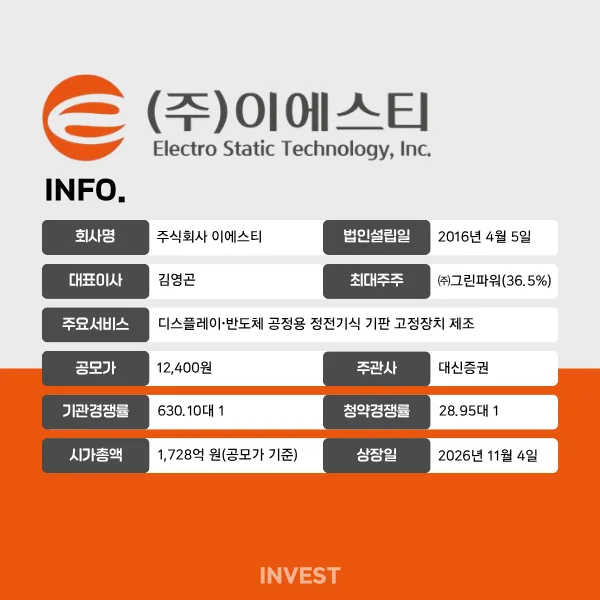
Ieseuti has concluded its public subscription for general investors with a competition rate of 28.95 to 1, ahead of its scheduled KOSDAQ listing on the 4th of next month. While the offering price reached the upper band of 12,400 won, only 0.24% of institutional demand was for shares with mandatory holding commitments.
Ieseuti, a company specializing in semiconductor and display process components, has concluded its public subscription for general investors ahead of its KOSDAQ listing. According to the lead manager Daishin Securities on the 23rd, Ieseuti's subscription competition rate reached 28.95 to 1, with deposits totaling 98.7 billion won. The scheduled KOSDAQ listing date is the 4th of next month.
The total offering consists of 2.2 million new shares. Of these, 550,000 shares, or 25%, were allocated to general investors. Based on the finalized offering price of 12,400 won, the total public offering amount is approximately 27.3 billion won.
The offering price was determined at the upper end of the target band (10,600–12,400 won) following institutional demand forecasting. During the demand forecasting held from the 14th to the 20th, 1,571 institutions participated, recording a competition rate of 630.10 to 1. The total number of requested shares reached 1,039,660,000. Of the total requested volume, 80.47% requested the upper end of the band, while 1.52% requested amounts exceeding the upper end.
However, the ratio of institutional investors requesting mandatory holding commitments was only 0.24% in terms of quantity. Out of the 2,489,000 shares requested for commitments, 66.3% (1.65 million shares) were concentrated in the 15-day commitment, revealing a gap between price-driven demand and the intent for long-term holding. As the allocation ratio for institutions with mandatory holding commitments fell below the 40% benchmark, Daishin Securities will take an additional allotment of 22,000 shares, representing 1% of the offering.
Immediately after listing, the volume of shares available for circulation is 5,243,400, or 37.62% of the total planned shares, valued at approximately 65 billion won based on the offering price. One month after the listing, 1,056,600 shares will be released from their lock-up period, increasing the cumulative float to 45.21%. Meanwhile, 6,823,646 shares (48.96%) held by the largest shareholder and related parties will be subject to a mandatory holding period of three years after listing.
Stock options and warrants also serve as potential factors for future equity dilution. As of the date the registration statement was submitted, unexercised stock options amounted to 1,421,000 shares, accounting for 10.2% of the planned shares. Additionally, 85,000 warrants granted to Daishin Securities can be exercised within 18 months starting from six months after the listing. The number of issued shares may increase depending on the future exercise of these rights.
Ieseuti Business Analysis
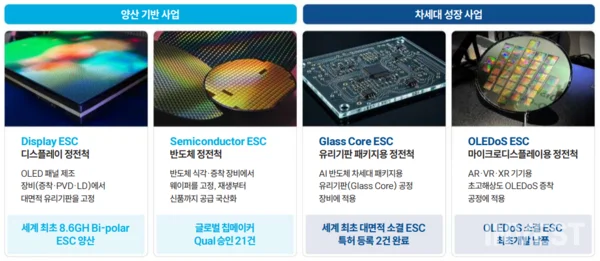
Ieseuti is expanding its business from electrostatic chucks (ESC) for displays into the semiconductor and advanced packaging sectors. An electrostatic chuck is a component that stably fixes substrates or wafers during the manufacturing process; there is demand for both new product supplies and the regeneration or repair of used units. The company is utilizing the technology and customer base secured in the display business to develop products for the semiconductor sector. However, as of the first half of this year, the revenue share by individual segment was 75.83% for displays and 24.17% for semiconductors, maintaining a display-centered business structure.
Major customers include Samsung Display and Applied Materials. Ieseuti has established product supply relationships by conducting joint development with these clients. In the semiconductor field, the company is pursuing an expansion of high-specification new product supplies based on its existing business of regenerating and repairing electrostatic chucks for equipment. According to the company, it has received quality approval (Qual) for 21 semiconductor electrostatic chuck products from its customers.
New business ventures include the development of glass substrate electrostatic chucks for advanced packaging and products for silicon-based OLED (OLEDoS). Revenue related to glass substrates first occurred in the first half of this year, totaling 1.3 billion won. However, since quality approval and product development do not guarantee continuous mass-production revenue, the expansion of new business revenue depends on future mass-production supplies.
A key business risk is the high level of dependence on major customers. Last year, the revenue share of the top three customers was 61.9% on a separate basis, and this reached 62.9% in the first half of this year. Because product demand is linked to the facility investment and utilization rates of display and semiconductor manufacturers, delays in investment or reductions in orders from major customers could directly impact performance.
Ieseuti is pursuing its KOSDAQ listing through the technology special listing system. In April, two professional evaluation agencies assigned the company an A grade and a BBB grade, respectively, for its electrostatic chuck design and manufacturing technology. As it is subject to relaxed management performance requirements compared to general companies, expanding revenue from new businesses and securing profitability remain major tasks following the listing.
Ieseuti Performance and Use of Funds
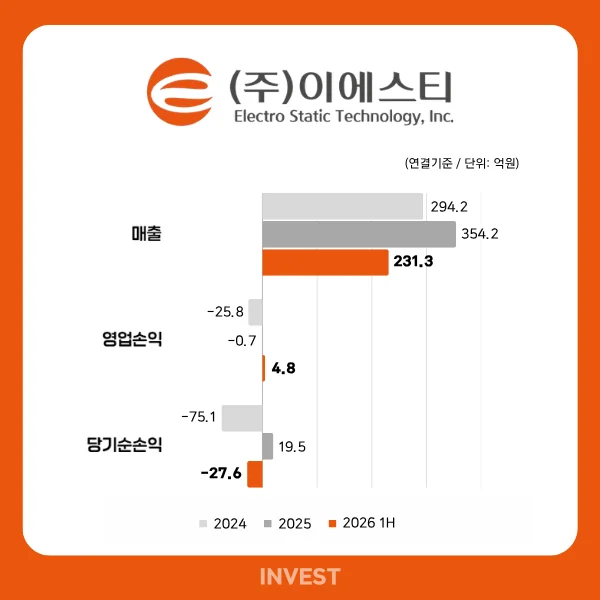
Following a significant reduction in operating losses last year, Ieseuti turned an operating profit in the first half of this year. On a consolidated basis, revenue for the first half of this year was 23.1 billion won, with an operating profit of 500 million won. The expansion of sales for high-value, large-sized electrostatic chuck products and improvements in product composition contributed to the recovery in profitability. However, the operating profit margin remains low at 2.1%.
Despite the operating profit, the company recorded a net loss of 2.8 billion won. This was due to the reflection of a 3.2 billion won loss on valuation of derivatives prior to the conversion of redeemable convertible preferred shares (RCPS) into common stock. These preferred shares were converted into common stock last May, resulting in the elimination of the related financial liability.
Cash flow has also deteriorated. In the first half of this year, net cash flow from operating activities showed an outflow of 4.3 billion won, turning negative from a net inflow of 700 million won last year. Accounts receivable increased from 4.6 billion won at the end of last year to 11.4 billion won in the first half of this year. If revenue growth does not lead to cash collection, the burden on working capital could increase.
Conversely, debt indicators have improved. Due to the conversion of RCPS into common stock, total liabilities decreased from 53.5 billion won at the end of last year to 22.4 billion won at the end of the first half of this year. However, as cash and cash equivalents also decreased from 14.7 billion won to 6.6 billion won during the same period, maintaining the improved financial structure will require the recovery of profitability and the stabilization of operating cash flow.
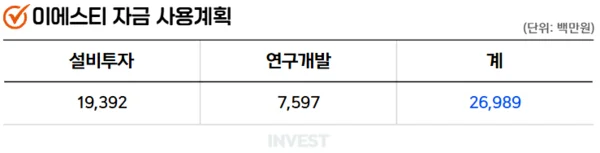
Ieseuti plans to invest the approximately 27 billion won in net proceeds secured through this offering into expanding production facilities and research and development. The company aims to expand production capacity for semiconductor electrostatic chucks and strengthen technological competitiveness for the development of next-generation products.
19.4 billion won has been allocated to facility investment. This will be used to expand production facilities for semiconductor electrostatic chucks and ceramic process manufacturing equipment, as well as to introduce manufacturing and quality inspection equipment for large-sized display electrostatic chucks and glass substrate products.
7.6 billion won will be invested in research and development. This will be used to develop next-generation products, including electrostatic chucks for glass substrates and silicon-based OLED, and to pursue the development of high-specification products for semiconductor processes and electrostatic chuck technology capable of responding to ultra-high and ultra-low temperature environments.
Covers IPO for INVEST NEWS GLOBAL, and also writes about Government.

Comments 0
Comments are currently disabled.