
[IPO] MS Bio's competitiveness as a 'profitable bio company' pays off... Subscription ratio of 1538:1
MS Bio successfully completed its public subscription for its upcoming KOSDAQ listing on the 22nd, driven by expectations for the medical device market and the company's profitability.
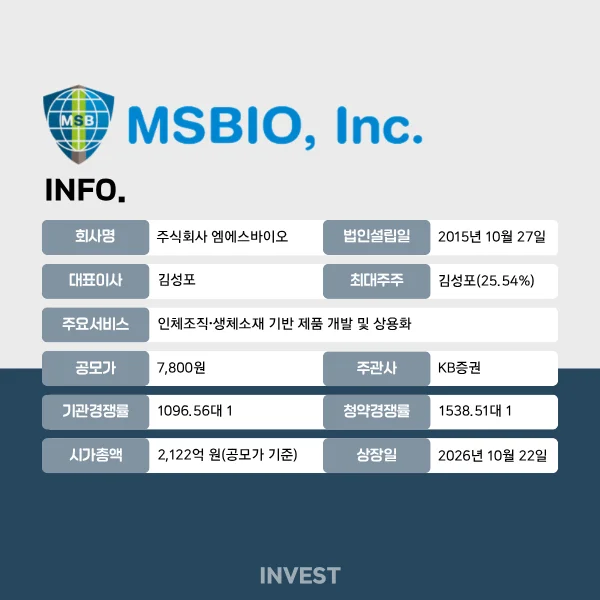
MS Bio has successfully completed its public subscription ahead of its upcoming entry into the KOSDAQ Market on the 22nd. It is interpreted that expectations regarding the growth potential of the medical device market and the company's profitability influenced investor sentiment.
According to the investment banking (IB) industry on the 13th, MS Bio recorded a final competition ratio of 1538.51 to 1 in the public subscription for general investors held for two days starting from the 12th. The number of subscription applications is estimated at 286,498 cases, with deposits totaling approximately 6 trillion won.
MS Bio offered a total of 4 million shares through this initial public offering (IPO). It was conducted entirely through a new share issuance method, and 1 million shares, which is 25% of the total public offering, were allocated to general investors. The finalized offering price is 7,800 won, resulting in a total offering amount of 31.2 billion won and an expected market capitalization of approximately 212.2 billion won. KB Securities served as the lead manager.
Previously, a total of 2,269 institutions participated in the demand forecasting for institutional investors held from the 28th of last month to the 2nd of this month. The number of requested shares was 3.11424 billion shares, recording a competition ratio of 1096.56 to 1. Looking at the distribution of requested prices, 98.7% of the total requested shares were concentrated at or above the upper end of the target band (6,800~7,800 won). The high price acceptance from institutions helped finalize the offering price at the upper end of the target range.
The mandatory holding commitment ratio was tallied at 30.62% based on the requested quantity. By commitment period, the 15-day commitment volume was the highest, placing relatively more weight on short-term commitments.
The number of shares available for circulation immediately after listing is 6,347,310 shares, accounting for 23.33% of the total planned shares to be listed. This is worth approximately 49.5 billion won based on the offering price. Three months after listing, the cumulative circulation ratio will increase to 45.65% due to the release of protective holdings, so the price volatility caused by the release of additional volume needs to be considered.
In addition, 375,000 unexercised stock options and 288,400 warrants granted to the lead manager are also potential factors for an increase in circulating volume. If new shares are issued following the future exercise of rights, the stake of existing shareholders may be diluted.
MS Bio Business Analysis
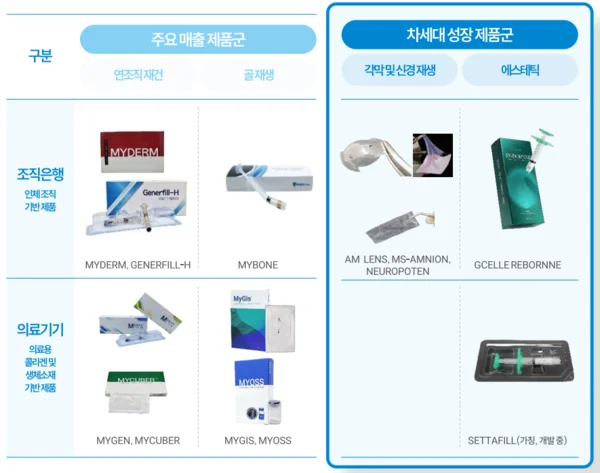
Established in 2015, MS Bio is a company that develops and manufactures human tissue implants and biomaterial-based medical devices. It operates with two main pillars: the tissue bank business, which processes and supplies human tissue, and the medical device business utilizing collagen and other materials.
Its core competitiveness lies in human tissue processing and collagen manufacturing technology. It increases the utilization of raw materials with splitting technology that precisely controls tissue thickness, and it implements product-specific specifications and physical properties by performing collagen purification and cross-linking processes in-house. Major products include the breast reconstruction implant 'MyDerm', bone graft 'MyBone', collagen tissue filler 'MyGen', and dental barrier 'MyGis'.
The reconstruction and regeneration medical material market is a field where demand is expected to expand due to aging and the increase in chronic diseases. In its investor relations (IR) materials, MS Bio projected that the domestic allogeneic dermal market for breast reconstruction will expand from approximately 78.4 billion won in 2025 to approximately 105.6 billion won in 2028.
As new growth engines, it presented skin aesthetics and next-generation medical devices. It launched the skin booster 'Giselle Rebonne', based on human tissue-derived extracellular matrix (ECM), in March this year, and is pursuing market entry by utilizing the sales network of GC Wellbeing. It is also pursuing the development of amniotic membrane-based ophthalmic products and collagen-based medical devices, as well as expanding overseas production and sales bases. However, the speed of future business expansion may vary depending on the progress of new product licensing and actual commercialization performance.
Market competition is also intense. In the domestic human tissue implant market, it competes with HansBiomed and L&C Bio, and various products using different materials are being released in the skin booster market. As a latecomer, it appears that product differentiation and securing distribution networks will be important for MS Bio.
Dependence on imported raw materials is also a burden. Last year, the import portion of the purchase amount for allogeneic tissue raw materials reached 97.1%. Since human tissue relies on donations and securing new supply sources requires approval procedures, it may be vulnerable to exchange rate fluctuations or supply chain disruptions. In 2024, there was a history of being subject to a three-month suspension of import business due to the omission of registration of the manufacturing source in the exporting country. Future renewal of tissue bank licenses and changes in health insurance fee policies may also affect the business.
Patent disputes are also ongoing. HansBiomed filed a main lawsuit and a preliminary injunction last May, claiming patent infringement of 'XenoPatch'. The amount of damages claimed is 100 million won. MS Bio maintains the position that no infringement occurred, but according to the corrected securities report, the preliminary injunction case is awaiting a court decision, so there is a possibility that the production and sale of related products may be restricted depending on the result.
MS Bio Performance and Fund Usage Plan
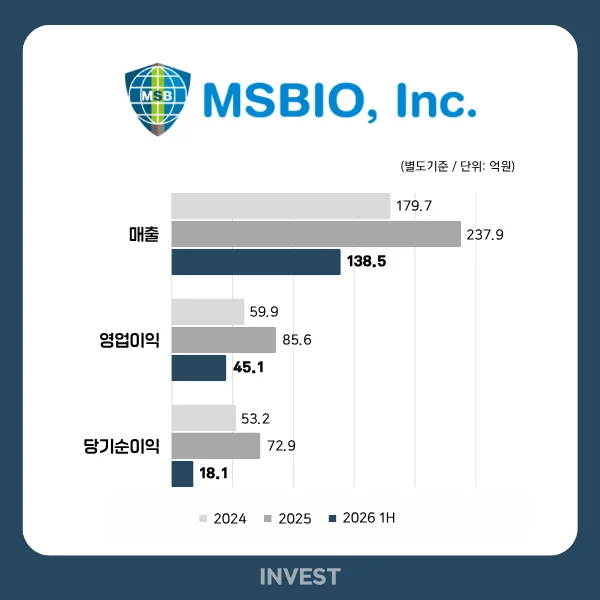
Unlike some bio companies that emphasize future growth potential, MS Bio differentiates itself by having already secured a foundation for operating profits. Last year, the operating profit margin reached 36%, and in the first half of this year, sales and operating profit increased by 26.5% and 21.3%, respectively, compared to the same period last year. However, the operating profit margin for the first half decreased to 32.6% due to an increase in commission expenses and stock-based compensation costs.
On the other hand, net profit for the first half was 1.8 billion won, a 43.4% decrease compared to the same period last year. This was due to the reflection of a 1.9 billion won loss on valuation of derivative liabilities related to redeemable convertible preferred shares and losses on valuation of financial assets. Since those preferred shares were entirely converted into common shares last April, the factors causing valuation gains or losses from the related derivative liabilities have been resolved.
The financial structure has also changed. The debt ratio, which was 94.3% at the end of last year, dropped to 3.8% as of the end of June this year. This is the result of debt decreasing and capital being bolstered following the conversion of redeemable convertible preferred shares into common shares. Borrowings from financial institutions were also fully repaid last year.
Cash inflows continued in operating activities. Cash flow from operating activities in the first half of this year maintained a surplus of 3.5 billion won. In investing activities, 14.9 billion won flowed out, but most of this was due to the acquisition of financial instruments. Cash outflow from financing activities was limited to 20 million won, and cash and cash equivalents at the end of the first half were recorded at 6.2 billion won.
However, the accounts receivable turnover ratio is on a downward trend. Accounts receivable at the end of the first half of this year stood at 7 billion won, an increase from the end of last year, and the allowance for doubtful accounts also increased. This was influenced by an increase in the proportion of sales to customers with relatively long payment collection periods, such as advanced general hospitals and agencies.
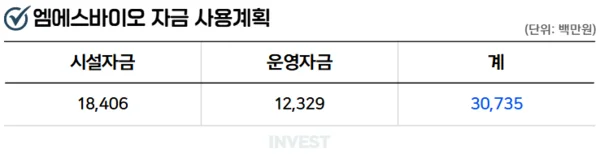
MS Bio plans to invest the net proceeds of approximately 30.7 billion won raised through this public offering into expanding production facilities and conducting domestic and overseas clinical trials. Among these, the largest portion of 18.4 billion won has been allocated to the construction of a new factory in Ochang, Cheongju, Chungbuk, while the remaining 12.3 billion won will be used for domestic and overseas clinical trials and the establishment of a production subsidiary in Vietnam.
The Ochang new factory is an investment intended to resolve the dispersion of production space and equipment expansion constraints at the existing Seongnam site. The company aims to complete construction in the first half of 2028 and begin commercial production in the second half. The plan is to expand the maximum production capacity, currently about 35 billion won in terms of sales, to a level of 70 billion to 80 billion won after the new factory begins operation.
Funds will also be invested in research and development and entering overseas markets. Domestically, 2.8 billion won has been allocated to clinical trials for MyDerm Recon, Cetaphil, and pig placenta-derived skin boosters. For clinical trials of three items, including amniotic membrane lenses, to enter the China market, 9.3 billion won will be invested, and 200 million won is planned to be used for the establishment and initial operation of the production subsidiary in Vietnam.
Covers IPO for INVEST NEWS GLOBAL, and also writes about Government.
![[IPO] 10 trillion won in deposits and 408:1 competition ratio... Will Elice Group maintain its 1 trillion won valuation?](/storage/investnews-global/2026/10/f3a1a543-f5f2-4175-bcdf-3c64e2ca4373-f97452e6-thumb.webp)
Comments 0
Comments are currently disabled.