Dongwon Parts achieves successful IPO amid mixed results for Baropharm and Nex-I
Dongwon Parts achieved high subscription rates following strong semiconductor component demand, whereas Baropharm and Nex-I saw lackluster results due to concerns over profitability and valuation.
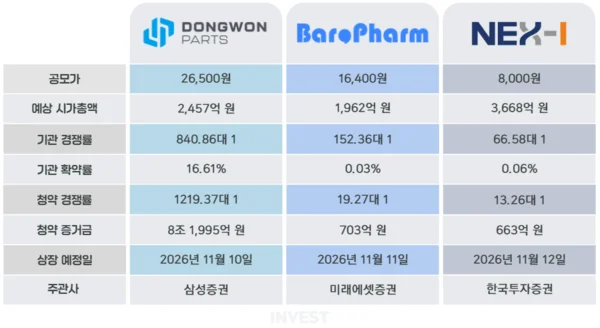
Dongwon Parts secured a 1219.37 to 1 general subscription competition rate during the first week of November, while Baropharm and Nex-I struggled with offering prices set at or below the bottom of their target bands.
The subscription results for Dongwon Parts, Baropharm, and Nex-I, which completed general public subscriptions in the first week of November, showed mixed outcomes. Dongwon Parts, which secured the upper end of its target price range during institutional demand forecasting, succeeded in attracting high interest during general subscriptions. In contrast, Baropharm and Nex-I saw relatively poor performance, with their offering prices determined at the bottom of and below the bottom of their respective target bands.
The differing subscription results for the three companies highlight how the divergence in investor sentiment seen during institutional demand forecasting carried over into general subscriptions. While Dongwon Parts secured investment demand based on the growth of its semiconductor equipment component business, Baropharm faced concerns regarding the sustainability of its profitability improvement, and Nex-I dealt with uncertainties surrounding its new drug development achievements and corporate valuation. Notably, Nex-I struggled to recover investor sentiment even after accepting a price more than 20% lower than the bottom of its target range.
'Operating profit 1.9 times higher in six months' Dongwon Parts sees 1219:1 subscription success
During the institutional demand forecasting held from the 22nd to the 28th of last month, Dongwon Parts recorded a competition rate of 840.86 to 1. The offering price was fixed at 26,500 won, the upper end of the target band (23,000–26,500 won), and the institutional mandatory holding commitment ratio was recorded at 16.61%. The general subscription competition rate reached 1219.37 to 1 with 8.1995 trillion won in subscription deposits, bringing the total offering amount to approximately 53.8 billion won.
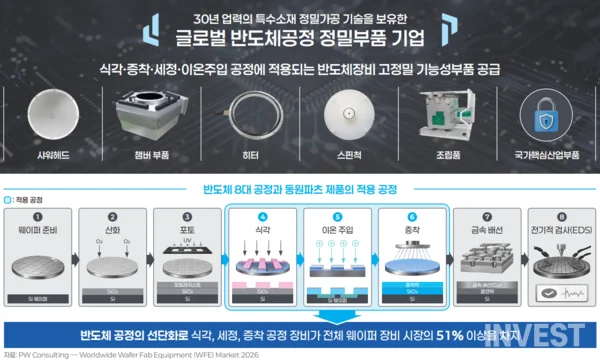
Dongwon Parts produces precision components used in front-end semiconductor equipment, such as etching and deposition processes. Its main products include showerheads, chamber parts, heaters, and spin chucks, which are in demand for both new equipment and the maintenance of existing machinery. The business structure is driven by component demand tied to semiconductor facility investment and equipment operation rates.
The improvement in performance is cited as a factor supporting positive evaluations from institutional investors. After recording 92.3 billion won in revenue and 7.8 billion won in operating profit last year, Dongwon Parts achieved 63.3 billion won in revenue and 14.5 billion won in operating profit in the first half of this year alone. Notably, the operating profit for the first half was approximately 1.9 times the total operating profit recorded last year. The operating profit margin also rose from 8.4% last year to 23.0% in the first half of this year, showing simultaneous growth in scale and profitability. This is analyzed to be driven by an increased sales proportion of high-value-added products.
However, high revenue dependence on major customers remains a burden. In the first half of this year, Lam Research and SEMES accounted for 45.9% and 33.4% of revenue respectively, meaning the two companies represented 79.3% of total revenue. This structure means that if the facility investment or order volume of specific customers decreases, earnings volatility could increase.
To expand production capacity, Dongwon Parts plans to invest 31.3 billion won of its 52.8 billion won in net proceeds into the construction and equipment expansion of the Incheon Namdong 7th Factory. The 7th Factory is a production facility intended to meet the component demand of its major customer, Lam Research; the company expects that this expansion will enhance its ability to respond to additional orders from the client. Nevertheless, despite the expansion of production capacity, the high revenue dependence on specific customers remains a challenge to be addressed.
Baropharm sees 19:1 competition rate despite revenue growth and turnaround to profit
Despite turning a profit in the first half of this year, Baropharm was unable to overcome conservative evaluations regarding its profitability. Regardless of its revenue growth trend, it is interpreted that institutional investors focused on the sustainability of its performance improvement.
The institutional demand forecasting competition rate was 152.36 to 1, and the offering price was set at 16,400 won, the bottom of the target band (16,400–20,200 won). The institutional mandatory holding commitment ratio was extremely low at 0.03%, leaving a burden regarding the volume of shares available for distribution in the early stages of listing. The general subscription competition rate was 19.27 to 1 with 70.3 billion won in subscription deposits, and the total offering amount based on the fixed price is approximately 29.2 billion won.
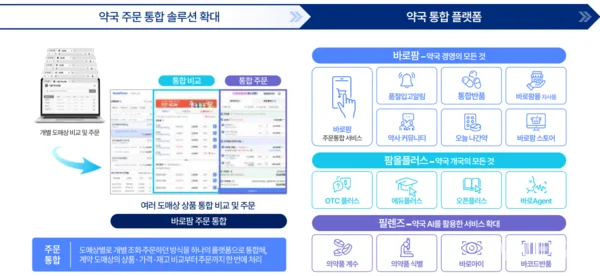
Baropharm operates a platform that supports pharmaceutical ordering, inventory management, and returns for pharmacies. Based on its pharmacy network, the company is expanding its business through pharmaceutical distribution and the sale of its own brand products. A strength of the company is its ability to expand services and product offerings for its existing pharmacy customers.
Despite revenue growth, Baropharm had continued to record operating losses through last year. While consolidated revenue last year was 96.7 billion won, it recorded an operating loss of 3.9 billion won. In the first half of this year, it turned a profit with 69.0 billion won in revenue and 2.2 billion won in operating profit. However, the operating profit margin was limited to 3.2%, indicating that profit generation is constrained relative to revenue expansion.
In terms of revenue composition, the distribution business holds a higher proportion than the platform business. In the first half of this year, the platform business accounted for 10.4% of total revenue, while the distribution business, such as the sale of affiliated products, accounted for 74.3%. Since there is a high cost burden in the process of purchasing and selling goods, the structure makes it difficult for revenue expansion to lead directly to improved profitability.
Baropharm plans to invest 14.0 billion won of its 28.9 billion won in net proceeds into establishing production facilities through a rights offering for an affiliate. The remainder will be used for AI technology investment, platform expansion, and brand marketing.
Nex-I lowers offering price by 23.8%, but investor sentiment remains 'cold'
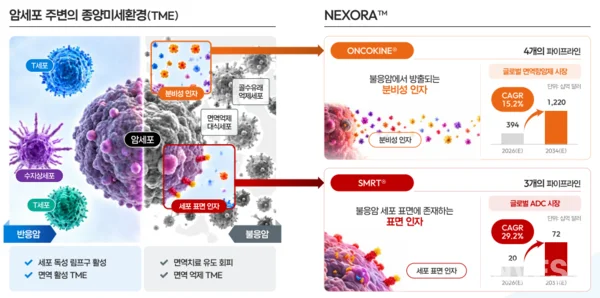
Nex-I failed to overturn the conservative evaluations of institutional investors even after proposing a price lower than the bottom of its target offering price band. As investment demand was also limited during the general subscription, uncertainties regarding the future profits of the drug development company were highlighted.
The institutional demand forecast competition rate for Nex-I stood at only 66.58 to 1. The offering price was finalized at 8,000 won, which is 23.8% lower than the bottom of the target band (10,500–13,000 won). The ratio of institutional mandatory holding commitment applications was only 0.06%, leaving a burden of stock price volatility due to the floating supply at the time of listing. The general subscription competition rate was 13.26 to 1, and the subscription deposit was tallied at 66.3 billion won. Based on the finalized offering price, the total offering amount is 40 billion won, which has been reduced from the original target band of 52.5 billion to 65 billion won.
Nex-I is a bio company that develops antibody-based immuno-oncology drugs targeting cancers that do not respond to existing immune checkpoint inhibitors or have developed resistance. Based on its proprietary drug development platform 'NEXORA', it is pursuing the discovery of new drug candidates, clinical development, and technology transfers.
The revenue structure relies on technology transfer contracts. The timing of revenue recognition for down payments and milestones at each development stage may vary depending on the progress of clinical trials and contract terms. Last year's revenue was 5.1 billion won, a 63.8% decrease compared to 14.1 billion won the previous year. It recorded an operating loss of 16.5 billion won and a net loss of 52.8 billion won. While the volatility of technology transfer revenue is high, operating losses continued as research and development expenses were continuously incurred.
In the first half of this year, it recorded revenue of 3 billion won and an operating loss of 2.1 billion won. Although the scale of the operating loss decreased, the net loss expanded to 75.4 billion won. However, the net loss includes non-cash accounting expenses, such as valuation losses related to redeemable convertible preferred shares, so there is a difference from the actual scale of cash outflows resulting from operating activities.
The burden of research and development funds in the future is also significant. Nex-I plans to use a total of 127.8 billion won, including 114.1 billion won in R&D expenses and 13.6 billion won in operating funds, from 2027 to 2029. Aside from the 39.4 billion won in net proceeds from the public offering, the company plans to cover the remaining 88.4 billion won with its existing liquid assets. As of the end of June this year, the total of cash and cash equivalents and short-term financial instruments is 102.4 billion won.
Based on the conservative fund plan presented by the company, the remaining funds at the end of 2029 are estimated to be 2.7 billion won. As a significant portion of the held liquidity will be exhausted if the planned R&D investment proceeds, there is a possibility that additional financing will be required if new technology transfers are delayed or clinical costs increase.
Although the offering price was significantly lowered below the bottom of the target band, uncertainty remains until the future profits, which served as the basis for calculating corporate value, are connected to actual performance. The clinical progress of major pipelines and additional technology transfer achievements are expected to influence the corporate valuation after listing.
Covers IPO for INVEST NEWS GLOBAL, and also writes about Government.

Comments 0
Comments are currently disabled.