
AI dubbing startup UnAI secures Pre-A funding to expand into sports
AI dubbing startup UnAI has secured Pre-A investment from Ilshin Investment, marking its second round of institutional funding following a seed investment from the Yoonmin Creative Foundation. The company plans to use the capital to advance its AI dubbing technology and expand its media solutions into the sports broadcasting market.
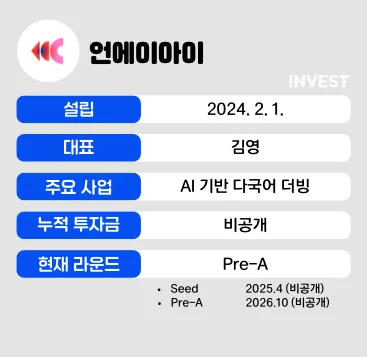
AI dubbing startup UnAI has secured Pre-A investment from Ilshin Investment to advance its technology and expand into sports broadcasting. The company, which has already delivered over 1,000 works to global platforms, plans to use the funds to develop its proprietary AI engine and increase service applications for its ASC sports commentary technology.
AI dubbing startup UnAI has secured Pre-A investment from Ilshin Investment. This marks the company's second round of institutional investment, following a seed investment from the Yoonmin Creative Foundation last April. Having been selected for the Ministry of SMEs and Startups' Deep Tech TIPS last year, the company is currently conducting an R&D project valued at 1.8 billion won to develop a system that analyzes the emotions in characters' voices and sentence context to reflect them in dubbing.
Established in February 2024, UnAI is a media solutions company providing multilingual localization for video content and AI sports broadcasting services. Its core business is AI dubbing targeting global Over-the-Top (OTT) platforms and Free Ad-supported Streaming TV (FAST) services. The company produces and supplies foreign language audio required for distributing films and dramas in other countries, utilizing AI technology to reduce the cost and time associated with traditional voice actor-centered dubbing production.
The company utilizes its proprietary 'DynEx' engine for AI dubbing. DynEx connects a process that separates the original video's audio, translates the dialogue, and then synthesizes and post-processes the voice based on the translation. This structure allows multiple production stages to be handled by a single engine. In particular, DynEx analyzes the meaning of the dialogue along with the character's emotions, tone, and speech intent. It is developed to reflect how expressions change depending on the scene and the character's emotions—even for the same sentence—into the translation and voice generation, maintaining the character's emotional expression while changing the original dialogue into another language.
Technology to preserve ambient sounds and non-verbal elements other than dialogue has also been applied. Rather than replacing all sounds in a video, the method produces foreign language dialogue audio while maintaining the original sound elements. Utilizing this technology, UnAI supplies dubbed content to major global platforms and has secured a track record of delivering more than 1,000 works, including films and dramas.
The sports broadcasting business is being developed through the 'ASC' (AI Sports Commentary) service. ASC is a technology that automatically generates the voices of casters and commentators based on sports video and match data. Unlike dubbing, which changes existing dialogue into other languages, ASC automatically generates caster and commentator voices based on the sports video and match data. In August this year, UnAI applied ASC to domestic professional football broadcasting, generating its first commercial revenue.
The investment will be used to advance AI dubbing technology and expand business targeting global platforms. Through this, the company plans to expand its content localization business for existing global OTT and FAST clients while increasing service applications in the sports broadcasting field using match video and data.
The focus was on explaining the actual business performance and scalability achieved in the real market rather than the mere possibility of the technology. Emphasis was placed on the fact that the company has secured major customers, including a global OTT platform and the number one player in the FAST market, and that recurring revenue can be generated through these clients. While platform operators spend significant time verifying technology and quality before signing contracts, once selected as a supplier, continuous orders can be expected. Furthermore, a structure was presented to secure revenue based on long-term customer relationships by increasing the scale of transactions through expanding the number of production languages and types of content.
The funds are planned to be invested in developing the proprietary AI engine and expanding global production infrastructure. By increasing development personnel, the company aims to improve the naturalness and emotional expression of synthesized voices and increase productivity by reducing correction work occurring during the broadcast content production process. The production network involving overseas professional personnel will also be expanded. Through the proprietary tool 'Dyna', external personnel will handle translation, voice generation, and inspection, while internal teams focus on process management and final quality assurance. Through this, the company plans to establish a production system that can maintain consistent quality even as supply volume increases.
The starting point was research during doctoral studies on how naturally AI can reproduce human expressions. At that time, while AI technology was advancing rapidly, there were still limitations in reproducing human emotions and subtle expressions. To improve this, an initial model was built based on the Attention model, after which the research scope was expanded to include sound source separation and timbre synthesis.
In this process, it was expected that general narration would be relatively easy to implement while synthesizing the melody and pitch of music, but it was necessary to perform the work of reproducing the complex expressions contained in human speech, including emotions, breathing, rhythm, and context.
The motivation for commercialization was the experience of watching dubbed content with a Canadian wife. Encountering unnatural dialogue and emotional expressions, it was determined that the technology being researched could be applied. Based on this, AI dubbing was chosen as the first business.
In the short term, the company plans to secure additional global OTT and FAST clients and increase the supply volume for existing clients to strengthen the foundation of recurring revenue. To achieve this, they are improving the quality of the dubbing engine and expanding the production system by utilizing professional overseas personnel. They are also pursuing the acquisition of overseas clients for the AI sports broadcasting service 'ASC'. Based on the experience of recording the first commercialization and revenue in Korea in August 2026, the goal is to expand the supply targets to overseas broadcasters and sports content providers and connect them to continuous contracts.
In the long term, the company aims to go beyond dubbing to become a voice AI technology company that naturally understands and expresses human speech. Currently, in the content production process, they generate more than 10,000 minutes of pre-processed voice data every month to use for engine training. Based on the accumulated technology and data, they plan to build a 'Human-like Voice Agent' that responds to Asian languages. The long-term vision is to develop voice AI that communicates naturally with humans by reflecting differences in pronunciation, intonation, and emotional expression for each language.
The audio field has high technical entry barriers, and commercialization is not easy. Securing excellent technology alone does not make a business viable, but if you overcome these barriers based on expertise, you can possess competitiveness that is difficult for other companies to follow easily. For content localization, it is important to have the capability to deeply understand various technologies—such as translation, generation, training/inference, and voice signal processing—and implement them as a single completed service.
If you are preparing to start a business, you must possess industry expertise along with AI utilization capabilities. If you do not accurately understand the problem you are trying to solve, it is difficult to differentiate yourself through effort or ideas alone. I believe we are currently in a period where new markets are being created as these two capabilities combine. However, as companies that have preempted the market accumulate technology and data, it may become difficult for latecomers to enter. There is no absolute time that is too early or too late for starting a business, but there are times when technological changes and market opportunities coincide. If you see a problem that can be solved by combining your expertise with AI, I hope you do not hesitate for too long.
※ This article was written after verifying the facts through reporting.
Covers Startups for INVEST NEWS GLOBAL.


Comments 0
Comments are currently disabled.