
Pitin seeks 12 billion won investment to expand EV battery swap hubs
Pitin, a commercial electric vehicle battery swap and subscription service provider, is pursuing a 12 billion won Series A investment to expand its infrastructure and technology.
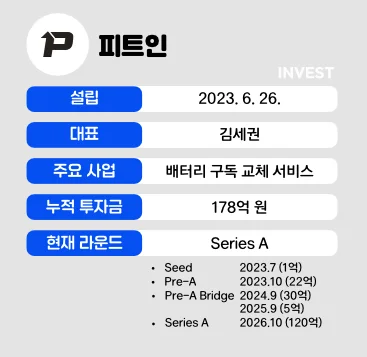
Pitin is seeking a 12 billion won Series A investment to expand its battery swap and charging hubs, aiming for a cumulative total of 17.8 billion won. The company plans to use the funds to build a second station in Incheon by February 2027 and develop automation technology.
Pitin, a company providing battery swap and subscription services for commercial electric vehicles, is in the process of attracting a Series A investment of 12 billion won. The company has already secured 11 billion won in payments, and the remaining 1 billion won is expected to be paid in early November following a preliminary investment review by investors. Once the remaining funds are received, the cumulative investment attracted will reach 17.8 billion won.
Pitin will deploy this investment to expand its battery swap and charging hubs. Following the first station in Anyang, the company is working to complete its second station in Incheon by February 2027. The Incheon hub is planned to feature a second-generation battery swap system and solar power facilities.
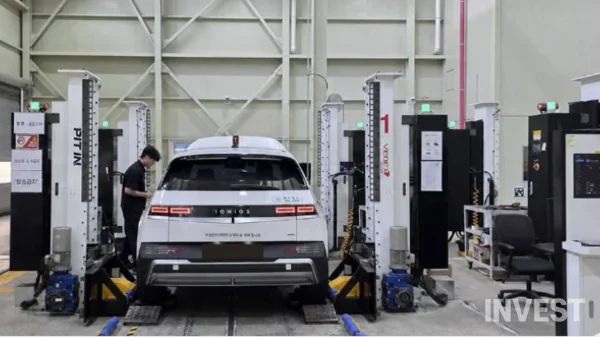
Led by CEO Kim Se-gwon, Pitin was spun off from a Hyundai Motor Group in-house startup in 2023. Kim spent approximately 15 years at Hyundai Motor Company, where he was responsible for improving electric and electronic systems and managing project organizations. Pitin provides battery swap and subscription services, membership charging, battery management, and vehicle maintenance and transaction services for commercial vehicles such as electric taxis and electric freight trucks.
The core business is the "Battery Swap Service" (BSS), which separates the ownership of the vehicle and the battery. Instead of users purchasing and owning a battery along with the vehicle, they subscribe to batteries managed by Pitin; when the battery level drops during operation, they can swap it for a charged battery at a station. A key advantage of Pitin's BSS is its ability to accommodate various vehicle models without requiring vehicle modifications or the standardization of battery pack specifications.
In June 2024, Pitin opened its first station in Anyang, Gyeonggi Province, to provide battery swap and charging services. As of August 2026, 37 vehicles belonging to four corporate taxi companies are using the battery swap subscription service, while 318 vehicles are using the membership charging service. Membership charging is a service where the battery is charged while remaining installed in the vehicle. Targeting electric taxis and electric freight trucks, the service applies membership fees and a settlement system; users can pay via the Pitin app and utilize car wash facilities and rest areas within the station.
Following Anyang and Incheon, the company plans to break ground on stations in Busan and Gwangju in the first half of 2027. In line with the expansion of its hubs, Pitin is developing automation for battery swapping and operating software to integrally manage multiple stations. The company is advancing technology that combines robots, lifts, and precision position control devices to move heavy batteries, alongside using cameras and AI vision to recognize the positions of vehicles and batteries. The operating software is intended to include functions for detecting abnormalities in facilities and batteries, analyzing causes of failures, and integrated control of multiple stations.
The company is also developing S2G (Station-to-Grid) technology, which connects stations and the power grid bi-directionally. This method utilizes the swap batteries stored at the station like an energy storage system (ESS), adjusting charging and discharging timing based on vehicle demand, battery status, and electricity rates. The company also plans to implement functions to link with solar power generation and supply stored power to the grid when needed.
The company emphasized business scalability confirmed through actual customers and revenue rather than just technological potential. By securing corporate and individual taxi customers at the first Anyang station, the company verified a structure that generates recurring revenue through battery swap subscriptions and membership charging.
For investors, the company explained an operating model that satisfies the demand for charging, battery management, and vehicle maintenance in a single location. It also presented the ability to expand hubs nationwide through AI and robot automation and standardized construction methods. The focus was on communicating that the business is an integrated infrastructure platform for the energy supply and maintenance of commercial electric vehicles, rather than being limited to battery swapping.
The funds will be used for station expansion, automation, and the development of energy management technology. Based on the operating experience of the first Anyang station, the company will build the second Incheon station and secure additional hubs in the metropolitan area. New facilities are planned to provide battery swap subscriptions, membership charging, battery management, and vehicle maintenance together. In this process, the company will also pursue cooperation models that utilize corporate taxi garages and existing energy facility sites.
As hubs expand, the company plans to increase the level of automation for battery swap robots and optimize charging schedules and facility operations using AI. Through this, it aims to reduce operating costs and establish a system for the integrated management of multiple stations. In the field of energy management, the company intends to develop S2G technology using 3 billion won in government R&D funds secured through its selection for Scale-up TIPS in 2026. The goal is to link stations with the power grid to reduce peak power demand and energy costs.
While performing automotive R&D for approximately 15 years at the Hyundai Motor Company Namyang Research Center, it was determined that not only vehicle technology but also an environment that allows for the economical operation of electric vehicles is important. In particular, while taxis and freight trucks have long driving distances and thus high potential for reducing energy costs through the transition to electric vehicles, many hesitate to switch due to the burden of operational losses caused by charging time, battery life, and vehicle residual value.
They viewed this problem as difficult to solve simply by installing more chargers. Based on the judgment that an energy supply method and battery management system tailored to the operational characteristics of commercial vehicles are necessary, they conceived the battery swapping subscription and integrated station business, and founded Pitin to build infrastructure that supports the efficient operation of electric vehicles.
The short-term goal is to establish the second station in Incheon and expand hubs to the Seoul metropolitan area. They plan to standardize design and construction methods and increase operational efficiency through AI and robot automation. They are also pursuing an expansion model that secures customer demand by cooperating with corporate taxi companies and logistics companies, and utilizing existing garages and idle land.
From 2029, they plan to full-scale the business of converting LPG charging stations into energy stations dedicated to commercial electric vehicles. This is to reduce the burden of securing new sites by utilizing existing facilities that have vehicle accessibility and energy supply foundations. They plan to expand the supply chain not only through directly managed stores but also through franchise and partnership methods.
In the long term, the goal is to build a nationwide network that provides energy supply along with battery and vehicle management. By combining AI, robotics, and S2G technology, they aim to possess grid efficiency functions and grow into an infrastructure provider that supports the charging and maintenance of autonomous taxis and logistics vehicles.
It is necessary to prioritize solving the problems customers face rather than the perfection of technology. Especially in the deep tech field, a lot of time and resources are invested in research and development, but business sustainability cannot be secured through technological prowess alone. You must verify whether the service is necessary enough for customers to pay for it and whether you can generate profit while providing it.
Pitin has also been modifying its business model while directly operating stations and meeting users. Customer feedback and operational data obtained in the field became the basis for determining the direction of development. In the process of experiencing difficulties, they also learned the importance of colleagues and partners who solve problems and execute together.
In other words, rather than spending time preparing perfect technology or plans, a process of verifying in the field and supplementing through failure is necessary. The standard for judging the sustainability of a business is the value that customers recognize and pay for.
※ This article was written after verifying the facts through reporting.
Covers Startups for INVEST NEWS GLOBAL.
Comments 0
Comments are currently disabled.