
NPU advancements showcased at Physical AI Tech Week in Seoul
The Physical AI Tech Week, held at COEX in Seoul, showcased advanced NPU hardware and robotic solutions designed to drive digital transformation in manufacturing, logistics, and service industries.
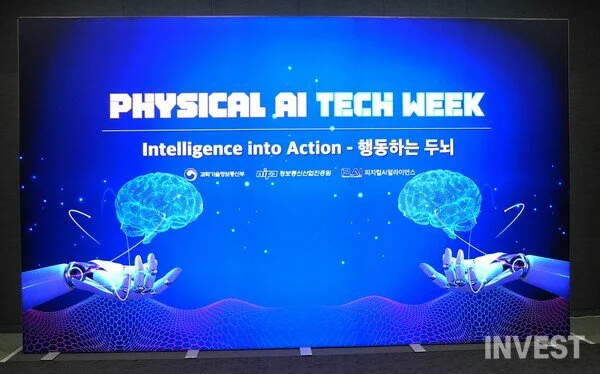
Rebellions and FuriosaAI presented proprietary NPU hardware at the Physical AI Tech Week held at COEX on the 13th and 14th. The event aimed to foster a technology ecosystem for manufacturing and logistics through public-private cooperation and the sharing of 2027 R&D directions.
Physical AI Tech Week was held at COEX in Gangnam-gu, Seoul, on the 13th and 14th. Hosted by the Ministry of Science and ICT and organized by NIPA and the Physical AI Alliance, the event was designed to foster a "Physical AI" technology ecosystem—technologies that sense and act in physical environments beyond digital spaces—and to promote digital transformation in key national industries such as manufacturing, logistics, and services through public-private cooperation.
The organizers aimed to share R&D and demonstration policy directions for 2027 and establish a related standardization roadmap through cooperation between government ministries, industry, and research institutes. Participating companies introduced solutions that can be deployed in manufacturing lines, logistics hubs, and hazardous areas while seeking business cooperation partners.
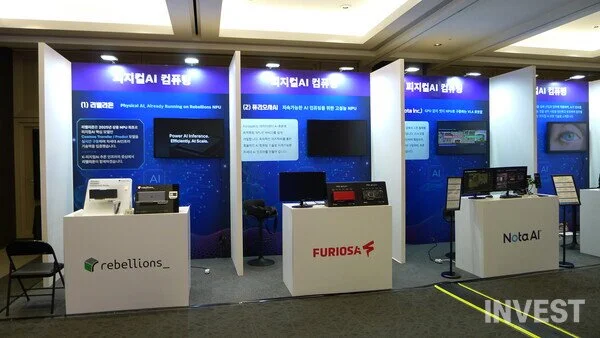
In the "Physical AI Computing" zone of the exhibition, domestic AI fabless companies including Rebellions and FuriosaAI showcased their proprietary NPU hardware and operating environments. Rebellions introduced real-time inference infrastructure for core Physical AI models based on its next-generation high-performance Neural Processing Unit (NPU), while FuriosaAI exhibited high-efficiency NPU architecture technology designed for data centers and edge environments. Nota AI unveiled an ultra-lightweight optimization solution to help process large-scale robot models in on-device environments with low latency.
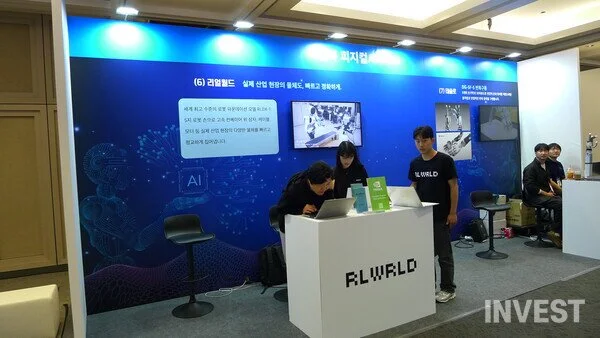
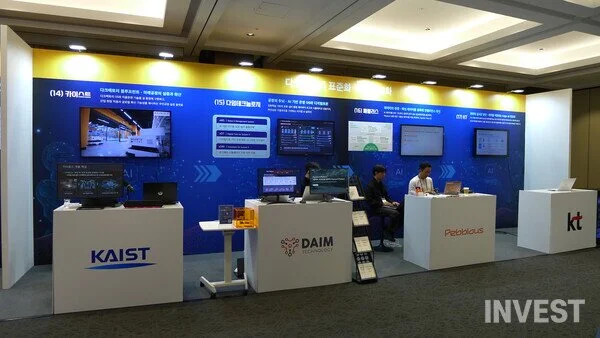
Other exhibition areas were divided into booths for various fields, including robot hands and vision foundation models for sensing and task control, facility integrated control, and data standardization. RLWRLD and Tesollo demonstrated technologies for precisely manipulating objects in unstructured environments by linking high-degree-of-freedom robot hand hardware with Vision-Language-Action (VLA) models.
In the demonstration area, maum.ai exhibited indoor and outdoor autonomous patrol and landmine detection equipment using quadruped robots, while LG CNS presented a simulated integrated industrial intelligence structure spanning from data factories to smart factories. Booths from KAIST, Daim Technology, Pebblous, and KT introduced dark factory blueprints, digital twins for integrated robot facility control, and an OS for data synthesis and quality verification for Physical AI. The exhibition also included hardware control technologies along with the supporting data infrastructure and standardization details.
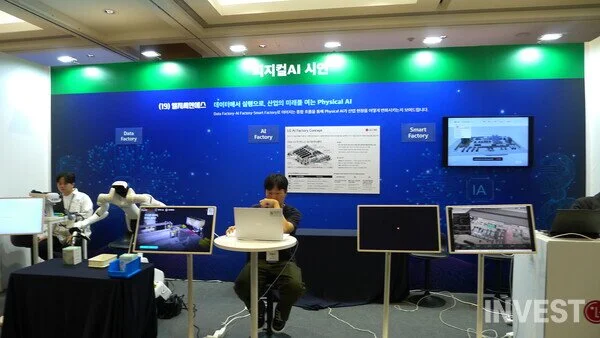
Notable in the technical demonstrations were the advanced software technologies and the movements of robots picking up irregularly shaking or inconsistently shaped objects. Unlike past methods that performed repetitive motions based on precise sensors and fixed coordinates, the software recognized the speed and direction of cables, boxes, and machine parts moving on conveyor belts in real time to control robot movements. By combining traditional algorithms that relied on visual information with behavior control software that immediately converts torque and pressure at the moment of contact into motor commands, the response speed and accuracy of machines in industrial sites appeared more stable.
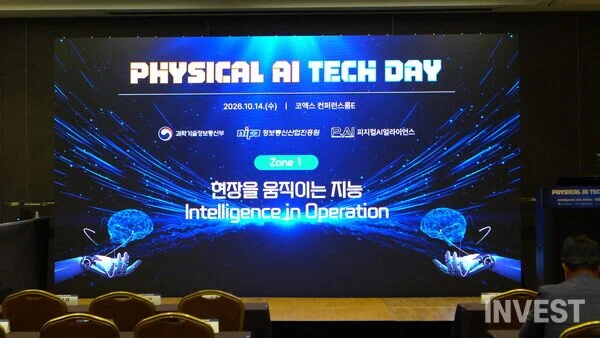
During the "Physical AI Tech Day" conference, keynote speeches and technical presentations were delivered by industry and academic experts, including Professor Sangbae Kim of MIT. Under the theme "Intelligence into Action," Professor Kim explained the principles of how the mechanical structures of the physical world combine with intelligence algorithms. Robotics experts from home and abroad shared methods for applying Robot Foundation Models (RFM) to tasks in manufacturing and logistics lines that are not yet automated. Speakers diagnosed that to link basic research achievements with field equipment, the design of real-time control models and industrial data processing systems is crucial, and these capabilities will determine future global competitiveness.
The presentations and exhibitions also addressed the effects of applying technology to actual processes. Discussions focused on practical utility, such as reducing error rates, minimizing facility downtime, and integration with existing factory operating systems when applied to specific processes, rather than the parameter scale or benchmark scores of generative models. Key considerations included whether the technology could assist or replace workers by performing tasks that remain unautomated in processes, and whether it could produce effects commensurate with the cost of introduction.
Meanwhile, a sense of crisis was evident among industry participants regarding the speed of global technological advancement and the pursuit by Chinese companies. As Chinese robotics and AI companies expand the field deployment of humanoids and smart manufacturing solutions—leveraging massive domestic markets, national support, and manufacturing plant data—to accelerate demonstration speeds, voices emerged stating that domestic companies must hurry with field verification rather than remaining at the stage of algorithm research. It was pointed out that if the speed of connecting research achievements to actual application is delayed, they may fall behind in global competition.
In response, participating companies focused on presenting actual operating results rather than merely explaining future development plans. Instead of concept-verification animations, monitors and demonstration stands at the booths repeatedly played operating logs collected from manufacturing plants, hotels, and logistics sorting centers, as well as real-time control videos from industrial edge equipment. Companies explained their technology's operation and application results through field data and control videos.
This event served as an opportunity to examine technical fields where early-stage startups can enter. Mass-producing hardware requiring large-scale capital or developing general-purpose foundation models from scratch can impose financial burdens on companies with limited resources. Strategies should focus on developing application software and data optimization systems tailored to specific manufacturing processes or service sectors by utilizing the standardization interfaces and NPU environments presented at the event. Execution capabilities are also required to secure field data through technical Proof of Concept (PoC) with large corporations and to present quantitative figures showing how much error was reduced in specific environments.
Covers Careers & Events for INVEST NEWS GLOBAL, and also writes about Education & Events.
Comments 0
Comments are currently disabled.