
Defense and semiconductor component makers see successful IPOs
Optonics and Yeonggwang YKMC have both achieved successful initial public offerings, recording competition ratios exceeding 1,300 to 1 during general subscriptions. While both companies plan to expand production capacity, they face different challenges regarding revenue concentration and industry investment cycles.
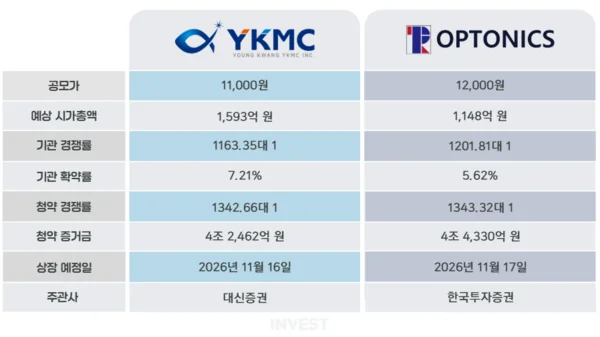
Optonics and Yeonggwang YKMC both achieved successful initial public offerings with general subscription competition ratios exceeding 1,300 to 1. While Optonics plans to invest 15.8 billion won of its proceeds into expanding production facilities, Yeonggwang YKMC follows a turnaround to a surplus last year.
Optonics and Yeonggwang YKMC have both achieved successful initial public offerings, recording competition ratios of more than 1,300 to 1 during general subscriptions. The offering prices for both companies were determined at the top of their respective target bands, confirming market interest in defense and semiconductor component manufacturers.
While both companies share the goal of strengthening their growth foundations by expanding production capacity, they differ in their earnings trends and risk factors. Optonics is expected to benefit from the expansion of defense exports, but its heavy reliance on a major customer remains a burden. Yeonggwang YKMC has continued to improve profitability following its turnaround to a surplus last year, but volatility tied to the semiconductor capital expenditure cycle remains a variable.
Optonics expects benefits from expanded defense exports, but revenue concentration remains a challenge
Optonics recorded a competition ratio of 1,343.32 to 1 in its general investor subscription held from the 5th to the 6th. The subscription deposit for this period was tallied at approximately 4.433 trillion won. The interest from investors is interpreted as being driven by expectations for growth in the ultra-precision optical component business for defense and plans to expand production capacity.
In the preceding institutional demand forecast, 2,317 institutions participated, resulting in a competition ratio of 1,201.81 to 1. The offering price was fixed at 12,000 won, the upper limit of the target band (10,000–12,000 won). While 98.21% of the requested quantity was concentrated at the upper end of the offering price, the mandatory holding commitment ratio was only 5.62%. Notably, a significant portion of the commitment requests was concentrated on a 15-day commitment, indicating relatively limited intent for long-term holding.
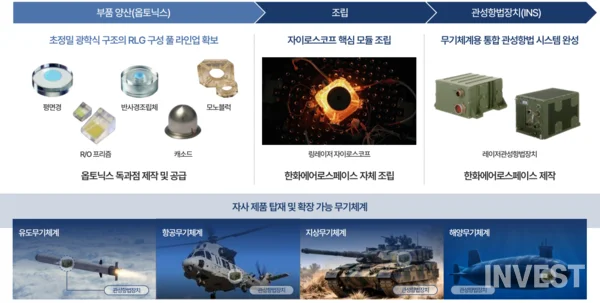
Optonics produces core optical components for Ring Laser Gyros (RLG) and Fiber Optic Gyros (FOG) used in inertial navigation systems. These components are applied to guided weapon systems such as Chunmoo and Cheongung-II, as well as ground weapon systems including the K9 self-propelled howitzer and the K21 armored vehicle. Because defense components are designed jointly with customers from the development stage and undergo strict quality verification before supply, entry for new companies is difficult. However, revenue tends to fluctuate depending on the mass production plans and ordering schedules of each weapon system.
While the company has maintained a profitable trend, recent growth has been limited. Last year, consolidated revenue was 25.6 billion won, a 3.1% increase from 24.8 billion won the previous year, with an operating profit of 3.6 billion won. In the first half of this year, revenue was 12.3 billion won and operating profit was 1.4 billion won, representing decreases of 1.4% and 39.7%, respectively, compared to the same period last year. The operating profit margin also fell from 14.1% last year to 11.5% in the first half of this year.
Revenue concentration is also a burden. As of the first half of this year, the revenue share of its major customer, Hanwha Aerospace, was 88.9%. While the expansion of production capacity by its major customer due to increased defense exports could lead to increased orders for Optonics, revenue volatility may increase depending on the mass production schedules of specific weapon systems. Last year, as the mass production phase for a specific ground weapon system entered its final stages, revenue from the flagship RLG components decreased by 13.9% from 20 billion won the previous year to 17.2 billion won.
Optonics plans to invest 15.8 billion won of its 25.7 billion won in net IPO proceeds into expanding production facilities. Of this, 14.2 billion won will be used to establish new production lines for fiber optic coils and interferometers for FOG. This is a strategy to expand its business scope from supplying existing optical components to supplying higher-level assemblies, thereby increasing the number of items supplied per inertial navigation system. The company aims to complete mass production preparations by the fourth quarter of 2027 and begin supplying new components from 2028.
However, supply contracts related to the new production lines have not yet been finalized. As the company is preemptively expanding facilities to match the production increase plans of its major customers, the investment performance may vary depending on actual order volumes and the operation rate of the production facilities. Since the new capital expenditure is also strongly characterized by responding to increased demand from existing customers, the structure of revenue concentration is expected to continue for the time being.
Yeonggwang YKMC, with '4.2 trillion won in deposits,' draws attention for improving profitability
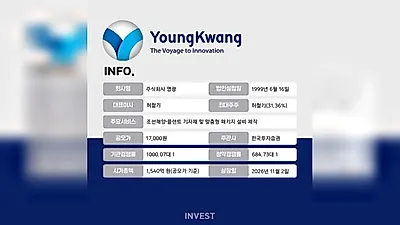
Yeonggwang YKMC has attracted investor interest following its turnaround to a surplus last year and a significant improvement in profitability in the first half of this year. During the general subscription held from the 4th to the 5th, it recorded a competition ratio of 1,342.66 to 1, with subscription deposits totaling approximately 4.2462 trillion won.
In the preceding institutional demand forecast, 2,376 institutions participated, resulting in a competition ratio of 1,163.35 to 1. The offering price was fixed at 11,000 won, the upper limit of the target band (9,400–11,000 won). 98.76% of the requested quantity was concentrated at the upper end of the offering price, and the mandatory holding commitment ratio was recorded at 7.21%. The total offering amount is 25.3 billion won.
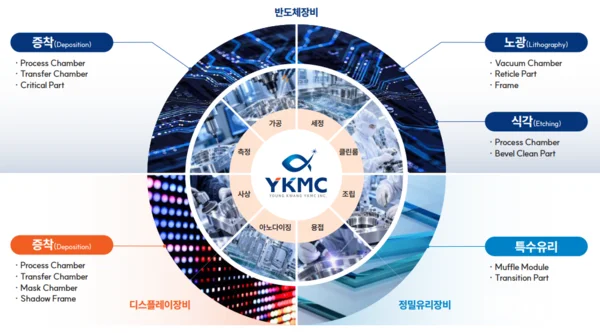
Yeonggwang YKMC is a company that produces precision components used in semiconductor and display manufacturing equipment. Its main products include chambers and lids for semiconductor equipment, as well as chambers for display equipment. The company possesses an integrated production system that performs everything from precision machining to surface treatment, cleaning, and assembly. While there are entry barriers due to the importance of customer quality approval and mass production supply history, performance is influenced by the capital expenditure and equipment orders of semiconductor and display manufacturers.
Recent performance has shown a clear improvement. Last year, revenue was 51.6 billion won, a 39.3% increase from 37.1 billion won the previous year, and it turned a profit with an operating profit of 4.5 billion won. In the first half of this year, it recorded revenue of 38.6 billion won and an operating profit of 7.9 billion won. This means the operating profit for the first half alone reached approximately 1.8 times the total annual operating profit of last year. The operating profit margin also rose from 8.7% last year to 20.6% in the first half of this year.
However, performance volatility due to the investment cycle of the semiconductor equipment market is a burden. In the first half of this year, the revenue share of semiconductor-related products was 63.4%, up from approximately 58% last year. While increased investment by major equipment manufacturers could lead to increased demand for components, revenue and production facility operation rates could be affected if capital expenditure is reduced or equipment orders are delayed. Additionally, there is a cost burden due to fluctuations in raw material prices and exchange rates, as the proportion of overseas procurement for aluminum, a raw material, is high.
Yeonggwang YKMC plans to invest 15 billion won of its 19.8 billion won in net IPO proceeds into expanding production facilities. It will use 8 billion won to purchase a third factory and introduce plating and precision machining equipment in 2027, and 7 billion won to purchase a fourth factory in 2028. While the company is pursuing the improvement of existing production facilities and the expansion of production capacity, it also carries the burden of new capital expenditures. The remaining 4.8 billion won will be used to purchase aluminum raw materials, and the future investment effects will depend on the order scale of customers and the operation rate of the new facilities.
Covers IPO for INVEST NEWS GLOBAL, and also writes about Government.

Comments 0
Comments are currently disabled.