
Intel shares suffer largest single-day drop since 1974
Intel's recent earnings highlight a divergence between booming AI data center demand and a struggling PC market, as rising memory costs squeeze PC manufacturers while benefiting memory makers.
Intel shares fell 28.58% on October 30 following third-quarter earnings that showed a 78% surge in Data Center and AI revenue despite a 5% decline in PC business revenue. CFO David Zinsner warned that supply shortages for Data Center products could persist until 2028.
Intel (INTC) shares closed down 28.58% at $65.76 on October 30 (local time), marking its largest single-day drop since 1974. The decline followed third-quarter earnings that showed a sharp divergence between business units: Data Center and AI revenue surged 78% year-on-year to $7.3 billion, while PC business revenue fell 5% to $8.1 billion.
The disparity between these two sectors is rooted in memory supply and pricing. While a shortage of server memory has driven prices up, rising memory costs in the PC market have increased production burdens and stifled demand. As memory manufacturers maintain their pricing power, fewer customers in the PC market are able to afford the elevated costs.
Rising prices driven by memory shortages
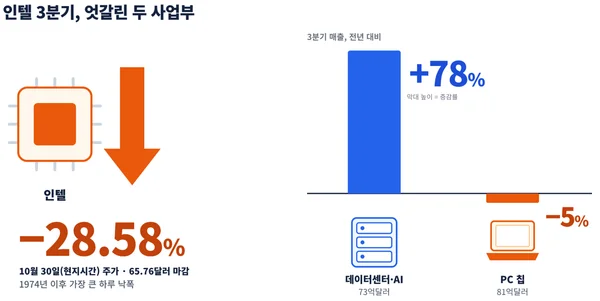
The primary obstacle for Intel's Data Center business has been supply rather than demand. During a conference call on the 29th, Intel CFO David Zinsner stated, "Demand for Data Center and AI products is significantly exceeding available supply." Intel faced supply disruptions due to component shortages and an accident at a factory in Israel. Zinsner expects these supply shortages to persist until 2028.
Memory shortages are also continuing. According to DRAMeXchange, the October contract price for commodity DRAM used in PCs reached a record high of $27.50, up 5.77% in a single month. This is due to memory manufacturers prioritizing production lines for server products, which has reduced the supply of commodity products. TrendForce predicts that while the increase in commodity DRAM contract prices will slow in the fourth quarter, it will still rise by 10% to 15% compared to the previous quarter.
BofA lowered its investment rating for Intel from 'Buy' to 'Neutral,' noting that the rapid increase in AI server demand makes it difficult for the burden of memory prices to ease for the time being. These concerns weighed on Intel's stock price.
Conversely, the rise in memory prices contributed to record third-quarter profits for both Samsung Electronics and SK hynix. Memory manufacturers are maintaining pricing power through a structure where supply is prioritized for server demand, with the remaining volume supplied to other markets.
'PC demand' falls, but price cuts remain difficult
The situation in the PC business is different. Intel provided a fourth-quarter revenue forecast of $15 billion to $16 billion, falling below the market expectation of $17 billion. The company expects PC chip business revenue to decrease by more than 20% compared to the third quarter. Intel also projected that the PC market will decrease by 12% this year and shrink by an additional 10% next year.
Intel attributed this to memory. During the conference call, Intel CEO Lip-Bu Tan said, "In recent weeks, customers have begun to signal a slowdown in PCs, citing memory prices and supply-demand conditions." CFO David Zinsner expects the PC slump to continue at least through the first half of next year, stating, "I do not expect a sustained recovery until memory supply improves and prices begin to normalize."
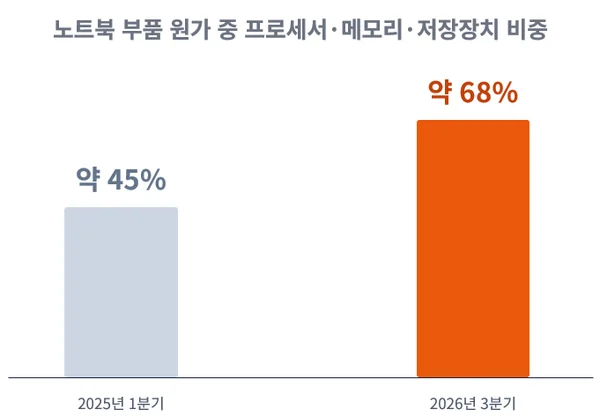
As PC manufacturing costs rise, it is difficult to lower selling prices even when demand decreases. According to TrendForce, the proportion of processor, memory, and storage components in laptop component costs rose from approximately 45% in the first quarter of 2025 to approximately 68% in the third quarter of this year.
Intel's CPUs are no exception. When component prices rise, PC manufacturers must either raise selling prices or accept reduced profits—both of which pressure sales volumes. Following Intel's earnings announcement, shares of Dell and HP fell by 10.77% and 9.58%, respectively.
The situation for South Korean companies is similar. While Samsung Electronics' semiconductor (DS) division drove third-quarter results, the Device eXperience (DX) division, which produces smartphones and TVs, reported that "difficult management environments, including rising component costs, are continuing."
The memory market as seen by Samsung and SK hynix
During the third-quarter conference call, SK hynix CFO Kim Woo-hyun said, "In PCs and mobile, shipments are decreasing due to the cost burden of rising memory prices and supply shortages, but the growth of the overall memory market will continue as the increase in AI infrastructure demand offsets this."
Samsung Electronics' memory division also expects that while mobile and PC demand may decrease somewhat next year, investment in AI servers will accelerate, centered around large data centers.
For server demand to offset the decline in PC and mobile demand, Big Tech companies must continue to expand AI investment. So far, there have been no signs of major Big Tech firms attempting to reduce investment; instead, they appear to be increasing capital expenditures. Based on this, some argue that concerns that AI investment has reached its peak are excessive.
November DRAM prices will be the first test
Intel's earnings demonstrate that while memory manufacturers maintain pricing power, the customers capable of absorbing high prices and supporting demand are effectively narrowing to Big Tech. A similar pattern has emerged in South Korea: while SK hynix and Samsung Electronics' DS division achieved record results by selling memory, Samsung Electronics' DX division, which purchases memory to build devices, reported a burden from rising costs.
The immediate indicator to watch is the November DRAM contract price. PC manufacturers are already adjusting costs by reducing SSD capacities. It remains to be seen whether this reduction in specifications will lead to a decrease in DRAM order volumes. Following this, the 2027 capital expenditure plans of Big Tech companies must be monitored. While the market expects investment scales to exceed $1 trillion, official figures for individual companies have not yet been released. Alphabet has only stated that it will "increase significantly."
It is too early to expect a turnaround in the PC market. Intel predicts the PC market will shrink by an additional 10% in 2027. In an interview, CEO Lip-Bu Tan said, "Memory prices have risen significantly. I expect this to become a very serious problem for all of us in 2027."
As PC manufacturers reduce their memory purchases, Big Tech demand must increase proportionally to sustain prices. The November DRAM prices will be the first indicator of whether this price support remains intact.
Comments 0
Comments are currently disabled.